Monday, November 10, 2008

Airports and Delays and Hotels, oh my!

In our rapidly expanding and highly globalized society today, the increasing demand for air travel is trumped only by an even greater increase in the cost of providing the service. With airlines scrambling to make up for rising costs of operation, they have less and less margin for error. One unexpected delay can lead to hours or even days of unpleasant ‘stranded’ situations for travelers. Displaced passengers need a place to relax and rest when they encounter this problem. Airport accommodations have developed through the years from the standard airport hotel to various sleeping solutions in compact pod-style rooms, a retired jet-turned-hostel, and even spaces in the airport terminal itself.

Airlines currently function in virtually the same procedures that have been in place for almost half a century. These old models of operation, which according to the Federal Aviation Association (FAA) are “based on 1960s technology”, have reached the end of their abilities to handle the kind of air traffic encountered now in the 21st century. This internal disability, combined with the recent downturn of the economy, rising costs of oil, and the ever-tightening budgets of consumers, have airlines taking a brutal hit. Some strategies to lower operation costs noticeably impacts the traveler. Checking in bags often costs a fee now, even for the first item. Unlimited free amenities like refreshments and drinks, once taken for granted, are now rare to find. Behind-the-scenes operations have changed as well to try to cover costs. According to JP Morgan, U.S. airlines will ground 512 airplanes by the end of this year, a number equivalent to the size of a small airline fleet. From an interview in The Wall Street Journal, a Continental spokesperson relays that “schedule reduction started with decisions about eliminating certain less-efficient aircraft from the fleet…then we looked at the profitability of routes, ending service where we did not see the prospect of making money in today’s environment” (McCartney). Statistics from the U.S. Bureau of Transportation further show that the number of flights has decreased 2% from last year to this year-to-date (July 2008). That’s about one hundred thousand fewer flights so far, and there are still a couple of months left until the year’s end. Reducing flights carries some benefits for consumers by freeing up crowded terminals, shortening lines through the air travel process, and freeing up space in the air for planes to get to their destination, presumably with fewer delays. However, while cutting planes and flights seems like a logical way of cutting costs, the conditions of the current airline situation actually cause more problems than solve.

For instance, despite the fact that more flights are being grounded now than before, there are still more delays than ever before as well. Based on a statement released in May 2007 by the FAA, “the percentage of on-time arrivals at the nation’s busiest airports has steadily declined each year since 2002, when 82 percent of flights arrived on time at the 35 busiest airports” (Fact). Last year, the percent of on-time flights decreased to 73 percent. There are several causes of flight delays that are recognized by the Bureau of Transportation in their data: Air Carrier, National Aviation System, Weather, Late-Arriving Aircraft and Security. Extreme and non-extreme weather related delays are consistently about 70 percent of the total delays. When weather is the deterrent for a plane to fly, there is really nothing outside of Mother Nature’s control to prevent or combat the impending delay. However, the problem arises, especially in light of the current airline situation, in the fact that “the retrenchment has brought most airlines in the USA back to thin profitability…has created an industry that is running full tilt all the time and more vulnerable to breakdowns when faced with adversity”, as written in an article by Dan Reed in USA Today.

Keeping the airline industry’s breakdown vulnerability in mind, another pattern worth considering is the number of passengers increasing steadily through the years. In a speech given by Robert Sturgell at a forecast conference of the Federal Aviation Administration, “load factors
remain high…they’ve gone through the roof in the last five years…that culminated in a record last year (2007), with 765 million passengers, or more than 2 million a day.” This number is expected to reach one billion by 2015 and forecasts indicate increases in demand doubling or tripling by 2025. Consequently, these record high passenger figures also hike up the percentage of seats filled on flights. Only a few years ago, one could expect to get on a plane and still have plenty of room to stretch around or switch seats with no question. Thinking about embarking on a plane now brings to mind uncomfortable and awkward situations of elbows from the neighboring passenger invading into the area of one’s own seat. For me, there is nothing worse than finally making it through the bureaucratic process to get to the correct seat, only to find it jammed between two passengers that have already claimed the armrests. Trying to move around the airplane for a better, unpopulated seat away from others is a difficult feat to accomplish. An analysis done by USA Today of U.S. Department of Transportation statistics reveals that “flights in the USA were more crowded than ever in 2007, running at 76% capacity compared with 60% 10 years earlier” (Frank). Though 76 percent seems capacity seems reasonable because it leaves almost a quarter of the seats open, these federal statistics only show an average of all flights at all times. It does not show the fact that most people fly during the day; likewise, most flights are almost at 100 percent capacity during the day.

The consequence? The combined circumstance of reducing operation costs, eliminating flights, and an increase of passengers and delays, means “all these packed planes create a huge problem when weather or other events cause airlines to go off schedule. There simply aren’t enough readily available seats to accommodate all the displaced travelers” (Reed). When travelers with layovers miss their next flight due to a previous delay, the probability of there being an available seat on the next plane is slim, much less even another available flight altogether. Thus, when there is an unexpected emergency such as the February 2007 ice storm in New York City, hundreds of travelers can get stuck in the dreaded airport limbo.

What can travelers do when encountered with this situation? Airline companies will only take care of problems if they are troubles within the airline’s control. Otherwise, travelers must fend for themselves. While airlines usually do not pay for meals or hotels, many will help by giving discounts. However, according to an article on flight delays in The Wall Street Journal, “carriers don’t offer specifics in their ‘Contract of Carriage’ documents—the rules that govern air tickets. And a few said they were unwilling to discuss specifics of their policies.” In the same article, an e-mail from a
JetBlue Airways Corp. spokesman states that “[JetBlue] leaders determine appropriate voucher amounts and accommodation based on the circumstances to meet our customers’ need in each unique situation…in order that customer expectations not be misguided we prefer not to disclose possible voucher amounts or hotel specifics” (McCartney). Because of this “play by ear” method that most airlines adopt, stranded passengers are more often than not forced to find their own solutions for food and rest, which is an unwanted hassle in an already high-stress environment.

Many businessmen and entrepreneurs have caught on to the needs of these mobile traveling consumers. Since displaced passengers desire places for peace and rest, the hospitality industry has found a profitable segment to tap into in airports all around the world. The global placement of traditional and innovative sleep solutions relates to the millions of international travelers suffering from jet lag and disorientation when traveling frequently between
different time zones. Designers and entrepreneurs have devised various methods of bringing comfort to the weary traveler.

First came traditional airport hotels, which developed out of several reasons: people with transfers that require overnight or day accommodation, aircrew and staff accommodation, and convenient meeting places for conference facilities (Lawson). The luxury hotels that have sprung up in airports are a huge business opportunity. ForbesTraveler.com notes that this trend is fueled by the wish to make money off of the “high occupancy and good
rate achieved at airport hotels…the occupancy rate for airport hotels in 2007 was 71.4%...a very healthy rate when compared to non-airport hotels, where it’s 65.1%” (Heydari). With amenities that range from a simple bed and bathroom to a spa, swimming pool, and world-class restaurants, airport hotels may well seem like an oasis in the midst of the hectic and sterile airport experience. Many are even contracted and designed by famous architects. Certain well-designed hotels that come to mind are the Kempinski in Munich, “the first luxury hotel at any European airport” as claimed by its general manager, Holger Schroth. Helmut Jahn, a Chicago-based architect, did the futuristic steel-and-glass design. Another luxury hotel recently made its debut at Dallas-Fort Worth International. The new Grant Hyatt is “integrated into DFW’s equally new $1.4 billion Terminal D: a sprawling two million-square-foot structure that brings a touch of European élan to the world’s third busiest getaway” (Heydari). Kempinski Hotel Airport, Munich
Grand Hyatt Hotel, Dallas Fort-Worth International Airport

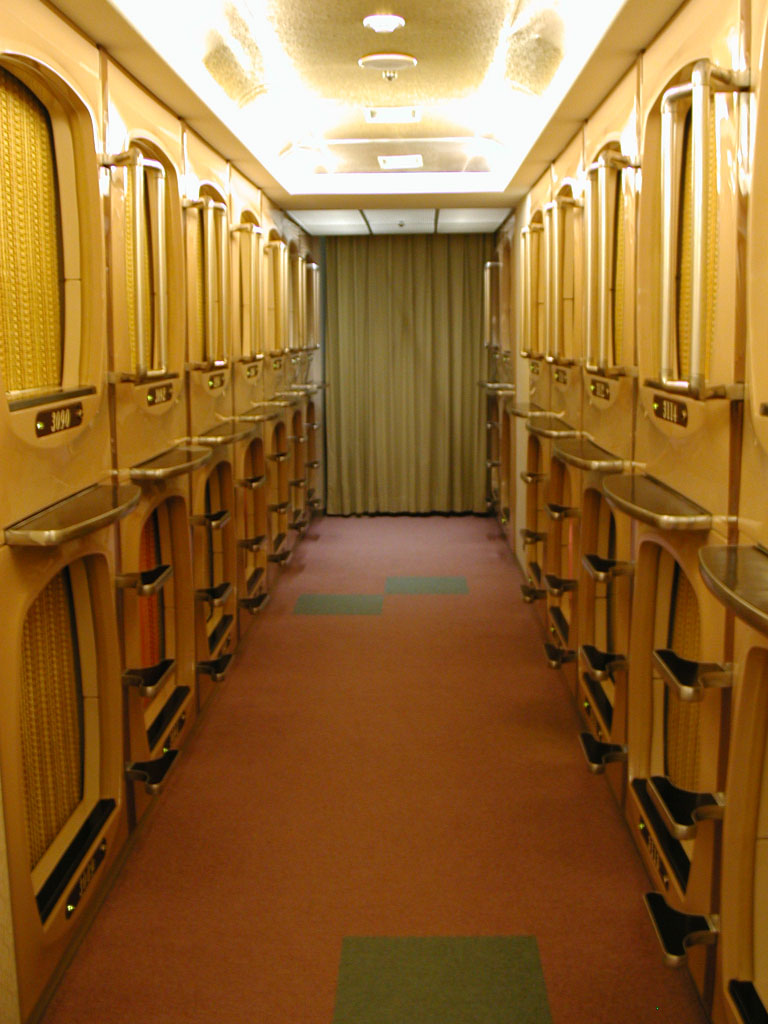
Though glamorous in their own rights, these ritzy getaways might be a little overwhelming for the average traveler or the frugal businessman. For someone who wants a quick nap or brief escape from the terminal environment, a new alternative comes in pod form, an idea adapted from Japanese pod hotels in the late 20th century. Designed by Japanese architect Kisho Kurokawa, the Capsule Inn Osaka opened in 1977 and was the first pod hotel, “with more than a passing resemblance to the drawers in a morgue…a weird but nifty addition to Japan’s space-starved cityscapes” (Buhrstein).view of sleeping compartments in a pod-style hotel in Japan

Originally designed for businessmen in transit, the pod idea easily conforms to the similar airport transit setting. Several companies have realized and adapted this concept. In Vancouver, MetroNaps opened in 2004, and installed several pod spaces in the middle of the airport to give travelers space for rest. Each pod consists of a giant bulbous fiberglass helmet over the top of a contoured chaise lounge. Once the helmet is secured, music is played in the sphere.
MetroNaps pod for rest

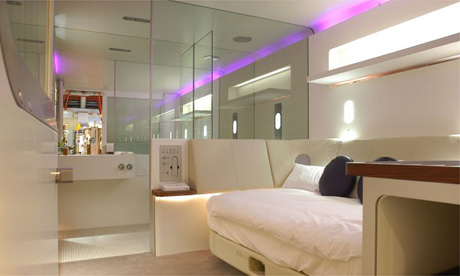
The most recent modification of the original pod system was accomplished by Simon Woodroffe, the CEO of the company that owns Yotel!. He envisioned an adapted version of the old Japanese hotel and created the futuristic pod-style hotels that currently exist in Gatwick and Heathrow airports in London. At Yotel, one can choose to stay any amount of time from the minimum of four hours and longer. Because it only takes “30 minutes to clean and ready a room for the next guest, compared with two to three hours at a typical hotel…daily occupancy runs between 150% to 180% since rooms can turn over more than once a day” (Jackson). This is an extraordinary figure that can boost profit margins considerably. Despite their small sizes that can measure as little as 65 square feet, airport pod hotels around the world are not without their amenities. Some offer gourmet room service, private bathrooms, “42-inch plasma TVs, heated bathroom mirrors that don’t fog, and Phillipe Starck designed décor” (Jackson). These economical but trendy capsule rooms match the discount airline trend of low frills and low cost. They save on costs by not needing as much labor to provide extra services, and in fact, there are “as few as one full-time employee for every 12 rooms at a pod hotel, compared with an employee for every two rooms in a typical budget hotel” (Jackson). As a cost-effective way of providing a place to rest, the space-saving pod-hotels also save on the amount of real estate on airport properties, an attribute most likely welcomed by airport architects, dollar-conscious CEOs, and environmentally conscious consumers.rooms in a Yotel pod-hotel

The newest variation on the small-room, low cost room idea will open for its first booking in Sweden at the Stockholm-Arlanda Airport this upcoming December. This innovative hostel is not only on the airport property, but is completely reconstructed from the interior of “a worn out jumbo jet of the model 747-200 built in 1976” (Histories). Named Jumbo Hostel, the idea is simply to have the same basic attributes of a hostel that can be found in similar large cities in Europe. Owner Oscar Dios, who also operates the Uppsala Vandrarhem och Hotell hostel, jumped at the opportunity in 2006 to buy and redo the old jet in order to take advantage of the two-for-one deal of saving on the cost of airport property and construction costs. Viewing the new budget living proposal as a landmark to stand at the entrance of the airport, authorities at Arlanda agreed to let the jet remain on the property. 450 seats were taken out to put in 25 rooms with three bunk beds each. Larger rooms such as the redesigned cockpit suite have its own bathroom. The entire plane works within Swedish building, climate, environmental, and energy regulations.
views of Jumbo Hostel, exterior and proposed interior

Although these airport options are soon to be or are already available for stranded travelers to choose, the majority of airports are still unable to provide sufficient places of rest. Sometimes the passenger must simply make do with what they are presented at the airport where they are stranded. Donna McSherry is a Canadian that understands the concerns of budget travelers. Her website www.sleepinginairports.com is a guide for people who are money conscious and travel weary. When the site was first launched in 1996, there were a measly three reviews. At the time of the last update on July 19, 2008, there were counted more than 5500 reviews of not only airports, but buses and trains as well (About). Airports, however, are the specialty of this site, and “Sleeper Scores” are assigned to each of the reviewed destinations, along with first-hand quotes and lists of amenities. Singapore Changi currently ranks as the best airport to sleep in, with Paris’s Charles de Gaulle airport ranked as the most hated. With amusing illustrations rather than actual pictures (the only thing that’s lacking on this site), the entire idea seems quite comical. Yet, the public response to this helpful guide is positive, and even major publications (New York Times, Time Magazine, etc) as well as the Frommer’s guide books approve.
Singapore Changi Airport's new terminal 3

The current situation of the airline industry may seem grim in light of the fluctuating economy and the quickly increasing numbers and needs of businesspeople and leisure travelers. Delays and passenger load capacities are at an all-time high. In the event of an air traffic emergency, whether due to uncontrollable or controllable occurrences, hundreds to thousands of passengers can be stranded at the gloomy limbo phase that is the layover terminal. Because it is essential for consumers to be comforted in times of high stress, several solutions have been devised to allow displaced travelers a place to rest. After examining options such as traditional airport hotels, pod-hotels, hostel jets, and the making-do-with-what’s-there tactic, there cannot be a consensus on the best option unless more factors are considered for each unique situation. Which airports are most in need of affordable housing options for travelers, and which can actually afford to construct one that will entice travelers to want to enter and enjoy? For some venues, the super sophisticated luxury hotel is the best option, while for others, a more affordable capsule room-by-the-hour will do the trick. Regardless of how travelers are getting more affordable ways of waiting out a flight, the important thing is that some designers and innovators recognize the context of the airline industry in our mobile world today and are addressing the problems that derive from it. How airline traveler accommodation will further improve in the future is yet to be seen, but there will certainly be developments as long as there is still the draw of producer and consumer benefits in this highly profitable airport hospitality industry.


Works Cited

Burshtein, Karen. "The Incredible Shrinking Room; Pods; More low-cost hotels crop up for budgettourists." National Post, October 20, 2007, national edition. http://www.canada.com/topics/travel/story.html?id=a6be0eec-345c-4187-9751-b9d36c1e657b (accessed October 10, 2008).

"Fact Sheet: A System Under Stress: Aviation Congestion." Federal Aviation Administration.
http://www.faa.gov/news/fact_sheets/news_story.cfm?newsId=8807 (accessed October 18, 2008).

Frank, Thomas. "U.S. flights hit peak loads in 2007." USA TODAY, March 25, 2008.
http://www.usatoday.com/travel/flights/2008-03-25-insideroutes_N.htm (accessed November 1, 2008).

Heydari, Farhad. "World's Best Airport Hotels." Forbes Traveler. http://www.forbestraveler.com/resorts-hotels/best-airport-hotels-story.html (accessed October 13, 2008).

"History and Curiosities." Jumbo Hostel. http://jumbohostel.com (accessed November 1, 2008).

Jackson, Candace. "A Pod of One's Own." Wall Street Journal, April 12, 2008.
http://www.djreprints.com/link/DJRFactiva.html?FACTIVA=wjco20080412000036 (accessed October 10,2008).

"July 2008 Airline Traffic Data." Bureau of Transportation Statistics. http://www.bts.gov/
press_releases/2008/bts049_08/html/bts049_08.html (accessed November 1, 2008).
Lawson, Fred. Hotels and Resorts: Planning, Design, and Refurbishment., 41. Architectureal Press,1995. http://books.google.com/books?id=TTmbB10De0gC&printsec=frontcover (accessed November 1,2008).

McCartney, Scott. "Canceled Flight? Your Inn Trouble." Wall Street Journal, April 2008.
http://p9003-www.lib.utexas.edu.ezproxy.lib.utexas.edu/sfx_local?genre=article&isbn=&issn=00999660&title=Wall%20Street%20Journal%20-%20Eastern%20Edition& volume=251&issue=88&date=20080415&atitle=Canceled%20Flight%3F%20Your%20Inn%20Trouble.&aulast=McCartney%2C%20Scott&spage=D1&pages=sid=EBSCO%3AAcademic%20Search%20Complete (accessed October 16, 2008).

McCartney, Scott. "The Middle Seat: A Downside of Cheap Fares: Flight Cuts --- Routes Vanish In Low-Fare Cities;Grounding 737s." Wall Street Journal, September 30, 2008. http://www.djreprints.com/link/DJRFactiva.html?FACTIVA=wjco20080930000027 (accessed October 16, 2008).

McSherry, Donna. “About This Site.” The Guide to Sleeping in Airports. http://sleepinginairports.com/about.htm (accessed November 1, 2008).

Reed, Dan. "Airlines Stretched So Thin that One Piece Out of Place..." USA Today, March 14, 2008,national edition. http://ezproxy.lib.utexas.edu/login?url=http://search.ebscohost.com/
login.aspx?direct=true&db=a9h&AN=J0E049517161407&site=ehost-live (accessed October
14, 2008).

Sturgell, Robert A. "Growth Ahead, But There's a But." Speech, Forecast Conference, Washington,D.C., March 10, 2008. Federal Aviation Administration. http://www.faa.gov/news/speeches/news_story.cfm?newsId=10185 (accessed November 1, 2008).

"Yotel Overview." Yotel. http://www.yotel.com (accessed November 1, 2008).

Image Sources

http://airport.all-hotels.com/images/hotels/travco/KEM-KEM_FRONT.jpg
http://blogs.dallasobserver.com/unfairpark/grand%20hyatt%20dfw.jpg
http://www.links.net/vita/trip/japan/lodging/capsulehotel/pix/facing-lg.jpg
http://www.freshpilot.com/metronaps-energypod-a-room-inside-a-room/
http://static.guim.co.uk/sys-images/Travel/Pix/pictures/2006/12/15/Yotel_X460.jpg
http://www.smh.com.au/ffximage/2007/07/27/Yotel_wideweb__470x314,0.jpg
http://www.jumbohostel.com/DynPage.aspx?id=64667&mn1=5293&mn2=5303
http://www.jumbohostel.com/Graphics/16524.jpg
http://www.cpgcorp.com.sg/admin/files/newsletter/Issue%202%202008/T3_checkin_hall.jpg

Airport Noise and What Has Been Done to Abate It

With the promise of travel to a new destination in a number of hours, airports are a very popular place. Whether for pleasure or business, passengers come to airports with the trust that the airports will help them get them to where they want to go. With so many people in one place and the nature of multiple loud planes, the airport can be a very noisy place. When it comes to public places, noise can be considered “unwanted sound” (Berendt 1). Noise can invade our “privacy and [disrupt] the enjoyment and full use of our surroundings” (Berendt 1).

Over exposure to noise can have many negative effects on people, one of which is hearing loss. “According to the U.S. Public Health Service” noise exposure is the cause of hearing loss in “10 million of the estimated 21 million Americans” who have hearing impairments (Suter 14).
Noise is “a nonspecific biological stressor, eliciting a response that prepares the body for action.” Noise does a lot more than just annoy a passenger who wants some peace and quiet before their flight; noise can “influence perceptual, motor, and cognitive behavior, and also trigger glandular, cardiovascular, and gastrointestinal changes by means of the autonomic nervous system” (Suter 24-25). Noise can increase “susceptibility to disease and infection” (Noise 3). It can be especially dangerous to those that already are “ill in mind or body” because they are “more susceptible... [to] heart problems and other diseases,” while it could only cause annoyance and irritability in other people (Noise 3). To avoid negatively affecting people’s health, it is important that in the planning of large buildings that are going to accommodate large crowds, like airports, the designers take into consideration what can be done to diminish unwanted sound. There are many factors for designers to account for that contribute to the noisy atmosphere in airports, such as the size of the building, materials used on the interior, flight announcements, crowds of people, and the aircraft engines.

Austin Bergstrom Airport (ABIA), an airport with only 25 gates, accommodated nearly 8.9 million travelers in 2007 (“Austin-Bergstrom”). A smaller airport, Des Moines International Airport (DSM), “enplaned 992,000 passengers” in 2007 (Erickson). A larger airport, John F. Kennedy International Airport (JFK), had nearly 48 million passengers travel through its terminals (“Facts”). With hundreds of people passing through the halls of an airport at one time, it is likely to get loud. People talking to each other or on their cell phones adds the element of conversation into the mix of noise.

Many airports use beeping carts to help transport elderly and disabled passengers to where they need to go. According to business class traveler Ken Walker, the carts are a good idea for airports like Minneapolis where the gate furthest away from the ticketing counters is over [half of a] mile away” (Walker). However, Walker explains that the cart drivers depend on tips, so they yell ‘excuse me’ while rushing “through the airport in pursuit of a fare,” without consideration of people’s “bags, toes or hips” (Walker). The beeping of the carts combined with the drivers’ yelling adds a lot to the discordant noise in the air. Austin Bergstrom is particularly proud of not having these electric carts . ABIA instead has personal helpers that come to assist passengers that need it and have previously submitted a request. The absence of these carts distinguishes ABIA as being quieter than those airports that have the beeping carts driving through their terminals (Coldwell).

Music played in airports is another contributing dynamic. Unique to the Austin airport, a new CD is made each week featuring only local artists. The CD is only played in certain areas. It is not played in the loading lounges in order to give passengers a break from that particular stimuli before they board their plane (Coldwell).

The constant announcements that are required to be played over the loudspeakers are another factor of noise in the airport. There are announcements warning travelers about airport safety measures, e.g. to not leave belongings unattended or if you see any belongings unattended to report it. The Federation Aviation Administration requires these announcements to ensure the safety of all those in the airport. Also, each gate has its own announcements about the loading process to the planes. These announcements are imperative to ensure that travelers get on the right plane at the right time in an orderly fashion.

To help eliminate confusion and more unwanted sound, each gate in an airport makes announcements that are localized to their respective loading area. At the JFK airport, the “the latest technology in loudspeaker design, the ‘phase array’ loudspeaker” is used to minimize the “requirements for acoustic treatment within the station architecture by using highly directional [optimized] loudspeakers” (“Airports”). Also, ABIA employees are encouraged not to shout or yell, but rather use radios to communicate with one another (Coldwell). All of these are efforts to abide by the regulations, but still work to lessen the noise in the air.

The design of airport structures is also a big aspect in how airports can engender much unwanted sound. In ABIA for example, the ceilings are very high and have exposed metal rafters. When noticing the metal rafters, tile floors and large glass windows, it would seem these materials would act as agents for noise to bounce off of; however ABIA architect Larry Speck and his team of designers took a lot of extra steps to help fight this from happening. The metal in the ceiling is in fact perforated, which is acoustically absorbent (Speck). Speck and his team also avoided the problem of rolling luggage strolling boisterously on tile floor by using a different technique for the flooring of the high-traffic areas, like the security stations, halls and baggage claim. They decided on terrazzo flooring because of its smooth texture (Speck). Terrazzo is “a flooring material of marble or stone chips set in mortar and polished when dry” (“Terrazzo”). With this type of flooring, rolling luggage can cruise easily through the airport without making continuous banging noises.

Most airports also use carpet as another sound absorbing material. Tile and terrazzo floors can allow sounds to reverberate; however, carpet “helps to attenuate noise in the departure lounge, which may stem from aircraft taking off on nearby runways” (Edwards 132). Carpet is used in the holding areas and the ticket counter areas, where the wear and tear is not too much for carpet (Coldwell).

Matt Coldwell, ABIA Art and Exhibit Coordinator, points out that the most important thing for keeping the inside of the airport quiet “is the sound proofing of the terminal from the outside noise generated from aircraft engines.” He explains that the windows at Austin Bergstrom are “dual paneled, gas filled” glass which drastically reduces the noise coming from outside (Coldwell). On a tour of ABIA, Coldwell pointed out that there are jute panels along the walls that serve to attract sound from the hustle and bustle inside the airport. Instead of the sound from people, music, announcements, planes, etc., bouncing back off the walls into the mix, the jute sucks up the sound particles and helps to reduce the noise.

Not only do airports have architectural aspects that serve to abate unwanted sound, but many also offer special quiet rooms for passengers to escape to. “Austin Bergstrom does not have a meditation room, but they do have Admiral & President Clubs” which “provide a quieter area for those who have membership” (Coldwell). “The American Airlines Admirals Club is an exclusive area” that allows members to get “away from the noise and semi-chaos of the airport” (Miner). Airports that have meditation rooms include Jacksonville and Ft. Lauderdale, FL, Albuquerque, NM, and Newark, NJ. These rooms are “warm and welcoming to those in need of meditation and reflection” (“Meditation”). For those that are easily overwhelmed by a lot of noise and stimulus, these quiet places are a good escape to be able to stay calm.

When airports were first built, not much consideration was given to reducing noise inside the buildings. As aviation increased, and airports became more popular, noise became more of an issue inside of the buildings. Nowadays people are more knowledgeable of the negative effects of noise and do more to avoid it. Airports care about the comfort of their travelers and do a lot to make sure they are comfortable. This includes fighting off unwanted sounds. Planes, the primary source of airport noise, are the reason airports are visited in the first place; thus, airports are noisy. Most noise in airports is “simply unavoidable” but with the help of good design and engineering, loud noise can be combated (Coldwell). Quieter plane engines have been engineered, however, they are still extremely loud. The growing market of sound absorbent materials has helped to allow airports be bearable places. Hopefully in the future there will be even less noise in airports with the help of designers and new products and idea to continue to abate unwanted sound.


Bibliography

“Airports.” ArupAcoustics. www.arup.com/_assets/_download/download547.pdf

“Austin-Bergstrom International Airport (ABIA) News.” Austin City Connection. 28 January 2008. http://www.ci.austin.tx.us/austinairport/actov_dec07.htm

Berendt, Raymond D. Quieting. The Minerva Group, Inc., 2000.

Coldwell, Matt. Personal interview. 07 November 2008.

Edwards, Brian. The Modern Airport Terminal: New Approaches to Airport Architecture. Taylor & Francis. 2005.

Erickson, Jim. “A New Era for the DSM International Airport Board.” Des Moines International Airport Year in Review. 2008. http://www.dsmairport.com/PDF/DSM Annual 07-08L.pdf

“Facts and Information.” The Port Authority of New York and New Jersey- Kennedy Airport.
http://www.panynj.gov/CommutingTravel/airports/html/ken_facts.html

“Meditation Room.” Albuquerque Official City Website. http://www.cabq.gov/airport /sunport-information/chaplaincy- program/meditation-rooms

Miner, Jennifer. “American Airlines Admirals Club: The Lounge Brings Luxury Back to Airports for Aadvantage Flyers.” Suite101.com Media Inc. 09 August 2007. http://luxuryresorttravel.suite101.com/article.cfm/american_airlines_admirals_club

“Noise: A Health Problem.” United States Environmental Protection Agency. August 1978.
http://www.nonoise.org/library/epahlth/epahlth.htm#introduction

Speck, Larry. Personal interview. 07 October 2008.


Suter, Alice H. “Noise and Its Effects.” Administrative Conference of the United States. November 1991. http://www.nonoise.org/library/suter/suter.htm#effects

"Terrazzo." The American Heritage® Dictionary of the English Language, Fourth Edition. Houghton Mifflin Company, 2004. 09 Nov. 2008. http://dictionary.reference.com /browse /terrazzo

Walker, Ken. “Beep! Beep! Beep! Airport Electric Carts.” AllBusiness.com, Inc. 02 June 2008. http://www.allbusiness.com/travel-hospitality-tourism/lodging/10206941-1.html

Unequal Access for Visually Impaired Travelers

From baggage check-in to boarding and deplaning, the experience of traveling by air is never an easy task. A traveler encounters exhaustive security procedures, problems with gate location—due to poor signage and overcrowded passageways— and is deluged with mass advertising and airline announcements as he or she makes his or her way through an airport terminal. According to Rudolph Brynn, “It is estimated that about 20% of the population faces barriers in using public transport…blind and visually impaired people face particular barriers in the field of transport that is often connected to access to information as well as access to infrastructure and the various means of transport themselves.” Although legislative bills have been passed concerning discrimination against disabled travelers, there is still a substantial lack of accessible navigational information and inconsistencies in services provided by airlines and airports, to assist the needs of visually impaired passengers when traveling by air.

In the August 19, 2007 issue of The Sunday Times, the headline read, “My mother is 84 and blind and was left for long periods with no information at two airports.” According to the London newspaper, the elderly woman was traveling between Gatwick and Manchester; her departing flights were both delayed on her roundtrip voyage. Assistance was provided to aid her through security and gate location. Her daughter, Angela Clough, states that her mother cannot read signs or screens and has trouble hearing announcements read over the intercom. She continues, “Both times, assistance left her for long periods with no information…when staff did appear, they did not introduce themselves to her; instead, she was pushed around like a piece of luggage, with no explanation. She felt vulnerable, tearful, and panicky. This is unacceptable.”
According to the Air Carrier Access Act, it is illegal for any airline to discriminate against travelers with disabilities. It requires airlines to be at the service of passengers with special needs, including providing “assistance with boarding, deplaning, and making connections,” as long as the traveler notifies his/her airline 48 hours in advance.

Although training is required for all respective airline staff that deal with special needs travelers (ACAA), when a spokesman for The Daily Telegraph anonymously called First Choice, Thomas, Thomas Cook, and Airtours concerning assistance for travelers with disabilities, he found customer service staff to be inadequately informed. “First Choice was the only exception,” states the spokesman, “none of these tour operators guaranteed to meet any disability requirements, meaning that all you can do is book and hope for the best.” The Air Carrier Access Act was passed in 1990, however, the two previous cases both occurred in 2007.

In another instance, Charles Starmer-Smith, a reporter for The Daily Telegraph, references a study done by Which? report on how Heathrow, Glasgow, Manchester, Gatwick, and Robin Hood Airport in Doncaster were the only five airports which allowed guide dogs to travel with special needs passengers on international flights. Although some airlines have their own guidelines on allowing or refusing the travel of pets on flights, The Air Carrier Access Act requires airlines to accept guide dogs on board any flight to accompany visually impaired passengers. This is because guide dogs are considered service animals, not pets.
These inconsistencies are certainly not specific to airline assistance, they are found in other areas concerning unequal access to information concerning navigation within airports, such as poor placement of Braille signs, dull color schemes—making various areas of airport terminals hard to distinguish—and various kiosks and display screens that are illegible to people with different levels of vision impairment.

An interview with Hope Lenaburg, a stylist at Regis Salon in Barton Creek Square Mall, revealed problems with wayfinding signage at Philadelphia International Airport in Pennsylvania. “My visually impaired friend and I arrived in Philadelphia. As I guided her towards the elevators, I looked up at the sign above our heads and noticed something was wrong. I couldn’t figure it out at first, but then it hit me; there was Braille at the bottom of the sign that was located seven feet off the ground!”

At the Suvarnabhumi Airport in Thailand, there are hardly any Braille signs near elevators. “‘Many signs have sharp edges which are a hazard to the visually impaired, and interior colour schemes are mostly monotone, making it difficult for a person with poor eyesight to navigate…’ said Topong, who is suing the AOT (Airports of Thailand) and former prime minister Thasksin Shinawatra, along with a few others, at the Administrative Court for failing to provide necessary access to the disabled as required by law.” (The Nation)

An interview with Diana Doan, a visually impaired University of Texas student, revealed how she has gotten lost at George Bush Intercontinental Airport, Hobby Airport, and Austin Bergstrom International Airport numerous times when she has traveled independently. “It would be easier to navigate if there were different colors at different gates and terminals. I can usually just read the gates numbers; however, each airline name is harder to read. If they could enlarge each individual image, it would be nice.” In Rudolph Brynn’s paper, “Blind and partially sighted people and transport — some important issues,” he mentions how there are many problems at airports with the placement of monitors and the size of text on screens that make retrieving information very difficult. This is reinforced by Diana’s comment oh how it is difficult to know when flights are delayed due to the small size of the television screens. Although she complains about airport infrastructure, Diana mentions, “At every airport I can always find someone to help me when I have questions about directions or flight information. I can always find my way, because there is someone who is nice enough to help. I just have to be brave and ask.”

Visually impaired passengers do not want to struggle to receive information that is easily accessible to every other traveler. In response, there are numerous attempts to provide visually impaired travelers with technology to aid independent navigation in airports. For example, students at Texas A&M University have begun a project using Radio Frequency Identification Systems (RFIDS). The network system will include “reduced function nodes (RFID tags), active nodes (Zigbee transceivers) and user-friendly device (RFID/Zigbee compatible dual-mode transceiver).” This network will provide visually impaired travelers with automated, up-to-date information such as flight delays or sudden gate changes.

In “Holding Patterns,” Peter Hall conducted an interview with Paul Milkensaar about a GPS, wireless wayfinding system to aid with navigation at Schiphol Airport in Amsterdam. With help from a student attending Delft University, Bueau Mijksenaar design firm decided to use a WiFi technology application to be used on passengers’ cell phones. If a traveler needs to find a restroom that is close by, he or she would simply speak into the phone’s receiver and say, “‘Show me a restroom within three minutes’ walking distance.’” The screen would then show that person a map with their location and an “animated line” leading towards the requested destination would appear. Other application features would include flight departure information, numerous language choices, and audio directions—specifically for visually impaired passengers.

A similar solution is a GPS system called Mobic, which is being developed at the University of Birmingham. The system is in the form of a wristband, which includes a GPS locator, a keypad, and a speech synthesizer. Once a destination is typed in, the GPS system calculates the most suitable path for travel and then verbalizes directions to the passenger through an earphone. Through the use of “landmarks,” the GPS system will make announcements relative to the person’s location.

Another navigational design innovation for visually impaired travelers is a three-dimensional wayfinding system called “haptic maps.” Researchers at the Aristotle University of Thessaloniki in Greece have created a system that takes video footage of a virtual space and translates it into a map constructed of a sequence of points. Pressure is then applied to the traveler’s fingers by a glove and wand designed to read the “virtual space points.” It is also accompanied by audio cues to allow for a better understanding of the traveler’s surroundings.

Most of these technologies are still under development and would take quite some time before they can actually be incorporated in current airport infrastructures. In the mean time, however, airports can fix a majority of their navigational problems by implementing a few simple guidelines concerning interior color schemes, and the accessibility and legibility of signs to make navigation for visually impaired travelers easier. The Ministry of Community and Social Services has an “Office Accessibility Checklist” that is used as a reference to make sure businesses facilities adequately accommodate visually impaired customers. These five simple guidelines can too be applied to airport environments:

1.) Design spaces so that walls, floors, doors, and furniture are high in colour contrast.

2.) Avoid floor patterns that are visually confusing.

3.) Any television set displaying information for the public should be captioned.

4.) Signs should be clear (easy to see and understand); concise (simple, short and to the point); and consistent (signs meaning
the same thing should always appear the same and be consistently located).

5.) Signs should have a clear typeface and contrasted from the background, such as light coloured, characters/symbols on a dark background, or dark coloured characters/symbols on a light background.

When a visually impaired passenger arrives at an airport, he or she is met with a wheelchair instead of being provided the necessary travel information to make his or her own navigation independently. Navigational and flight information should be equally accessible to visually impaired travelers—whether through verbal assistance, Braille, or other mediums—at all times, in all airports. These inconsistencies must be addressed in order to make air travel for visually impaired passengers easier, more enjoyable, and more independent.

Sources:

Air Carrier Access Act, 1990.
http://www.disabilitytravel.com/airlines/air_carrier_act.htm

Brynn, Rudolph. “Blind and partially sighted people and transport—some important issues.” August 08, 2006. http://www.dok.no/blind-and-partially-sighted-people-and-transport-some-important-issues-.344720-50923.html

Clough, Angela. “My mother is 84 and blind and was left for long periods with no
information at two airports.” The Sunday Times. London. August 19, 2007. Features. Travel. Pg. 11.

Doan, Diana. Personal Interview. November 09, 2008.

“GPS will guide the blind.” University of Birmingham. Popular Mechanics. August 1997. Vol. 174. Issue 8. Pg. 18.

Hall, Peter. Mijksenaar, Paul. “Holding Patterns.” Else/Where: Mapping. Minneapolis. 2004.

Harris, William. “How Haptic Technology Works.” How Stuff Works. http://electronics.howstuffworks.com/haptic-technology4.htm

Lenaburg, Hope. Personal Interview. November 5, 2008.

“Quick Reference Guide to Accessible Constituency, Riding Association, 
Central Party and Campaign Offices. Office Accessibility Checklist” Ministry of Community and Social Services. Accessibilities for Ontarians with Disabilities.
http://www.mcss.gov.on.ca/mcss/english/pillars/accessibilityOntario/planning/accessible/3_checklist.htm

Quilty-Harper, Conrad. “Tactile 3D maps could help blind people navigate.” Aristotle University of Thessaloniki. Posted April 7, 2007. 5:15PM. Engadget. http://www.engadget.com/2007/04/07/tactile-3d-maps-could-help-blind-people-navigate/

Rojanaphruk, Pravit. “More toilets for disabled sought at new airport.” The Nation. Thailand. November 7, 2006.

Srinivasan, Rangakrishnan, Hussien Faisal A., Turker, Didem Z., Aslanzadeh. Hesam A., Mobarak, Mohamed, Cortes, Ferando P., Sánchez-Sinencio. Edgar. Design of an RFID / Zigbee Network for Blind Navigation. Texas A&M University. Summer 2004/ Fall 2005. http://amsc.tamu.edu/research/Research%20Summary/Rang2.pdf

Starmer-Smith, Charles. “Disabled travellers 'still get a raw deal' Which? report shows industry is not doing enough to help passengers with special needs, says Charles Starmer-Smith.” The Daily Telegraph. London. September 8, 2007. Travel. Pg. 4.

Airport Design for Passengers with Disabilities

Airports are notorious for being disorienting and providing a sense of uncertainty to many passengers. For a person with a physical disability, airports can be quite an ordeal. Orientation of oneself in his or her surroundings, navigating through the space, and mobility within the space are three key aspects necessary to efficient transportation. A major airport design challenge is creating one system that efficiently provides the same information and travel accessibility for passengers with disabilities and for those without.

A study by Dada and Wirasinghe showed that the two biggest factors that slow wayfinding is the number of decision points and the number of level changes. The study also showed that people who are visually impaired tend to orient themselves every 40 meters instead of every 100 meters like a normal-sighted person. With 17 million passengers with disabilities flying each year (De Lollis), airports must take this into consideration when designing spaces such as long corridors or large, open rooms. Check-in and Information desks are of major importance for the disabled; therefore airports should make sure these locations are clear, visible, and easily accessible. For those who are partially blind, color and tonal contrasts are key visual aids. However, an efficient sign system does little good for the fully blind that must seek alternate wayfinding.

Another challenge for persons with disabilities in airports is getting the assistance they need, while negative attitudes from the airport staff seem to be an ongoing problem that makes this even more difficult. According to the US Department of Transportation, passengers filed 10,193 complaints in 2004 with US airlines, and two-thirds of these complaints were wheelchair-related (De Lollis). One common problem is long waits for help. Once an employee is there to assist, they might be uneducated on proper procedures or not know how to work the passenger’s equipment. People with disabilities have complained that the Sydney Airport forces them to walk long distances before being helped by a wheelchair, or must stand for long periods of time waiting for a wheelchair (Goldberg Bellevue Hill). This is a problem of both the assisting employee and of the airport design that failed to take this issue into account. It is also up to the passenger to find his or her own help. Travel agent Jerry Lyon remarked, “The only thing we can do is put in a note to the airlines if a passenger needs a wheelchair or is blind. The passenger must contact the airport separately if extra assistance is needed.”

The government has done some to help travelers with disabilities by enacting policies relating to the less able in airports. The Disability Discrimination Act in 1995 made it unlawful for airport employees to either refuse to serve a person with a disability for a reason that relates to their disability, to offer substandard service to a person with a disability, or to provide a service on different terms than those who do not have a disability. Adjustments to the act in 1999 included the provision of auxiliary aids to services. After five individuals with disabilities sued Northwest Airlines for not providing adequate assistance during their travels in 2008, a federal judge ruled that the Americans with Disabilities Act does in fact apply to airports under the ADA’s definition for “places of public accommodation”, and the people were entitled to proper assistance by the airport staff (Compart, 3).

The Transportation Research Board did a study in 1990 to improve airport access for persons that are disabled or elderly. It resulted in five formal papers that addressed, “the market for airport services among people with disabilities; the policy and regulatory framework for making airports accessible to people with disabilities; the state of airport design, technology, and operational logistics with regard to disabled persons; and International experience and practice in airport access for disabled and elderly people.”

The European Union implemented three rules in 2007: equality of treatment of persons affected by reduced mobility, free assistance in all EU airports, and free assistance on board. In the Irish Independent, columnist Bernard Purcell stated, “Until now airports and, mainly but not exclusively, the low-cost airlines have argued between themselves as to who must provide the facility and who should pay the cost, sometimes resulting in legal action by passengers.” Since 2008, European regulations entitle people to compensation for damaged equipment (Corner), but these reparations are just a “Band-Aid” solution to the deficiencies of the design. The way an airport is designed could solve these problems before the damage occurs. For example, The Department of Transport has made certain requirements for airports in regards to air travel for the disabled. These include proper signage, appropriate distance of ticket issue from driver’s hand, close proximity of help points, and fully accessible transitions to taxis and buses. While these requirements are significant to the assistance of the disabled, they may be unnoticeable to those who do not have a disability.

The Transportation Security Administration also does its part to assist the disabled, but they are only concerned with checkpoints. The TSA website reads, “TSA officers are trained to provide whatever assistance they can to persons with hearing disabilities.” It does not state, however, how many TSA officers are trained to provide adequate assistance to persons with hearing disabilities. Perhaps all employees should go through at least some training before inevitably working with issues they may not understand or know how to handle. AirAsia has taken this into account and put into practice “Disability Equality Training” for its cabin crew and staff to “give them a better understanding of the needs of disabled passengers” (Mokhtar).
Another factor that must be considered in designing an airport is the need of service animals for certain passengers with disabilities. According to TSA, to relieve a service animal one must leave the building and then reenter through security for a second time. This inconvenience is unavoidable during long layovers or before long flights. A small outdoor area past security may be a simple solution to this issue.

Modern technology is also providing assistance to the disabled. One group working in the Computer Science Assistive Technology Laboratory at Utah State University has invented a system of robot-assisted wayfinding for the disabled in indoor environments. It works through mobile robotic guides and small passive RFID sensors embedded in the environment (Kulyukin). This system of wayfinding could eventually be useful in spaces as large as airports. A group from Tokai University in Kanagawa, Japan developed a navigation system in 2001 that uses optical beacons set on the ceiling. Using an infrared signal, a navigator guides the user with an artificial voice. It has been tested in hospitals, and could likely be useful in airports if improved upon (Magatani).

Gerald R. Ford International Airport and the Birmingham International Airport are applying the latest technology to assist those wearing hearing aids (Airport Announcements). The Induction Loop, or hearing loop, is a system that amplifies flight announcements directly into the passenger’s hearing aid using a special receiver. James Koslosky, the airport’s aeronautics director, said that “adding a hearing loop would be a natural move” since many people with hearing disabilities already use hearing aids. Birmingham International Airport has also introduced the “Deaf Alerter” system for the hearing impaired. The Alerter is a hand-held device that is permanently connected to the airport’s fire alarm system. In the case of an emergency, the Alerter will vibrate and flash until the person holding it is outside of the building. BIA also uses a vibrating pager system for the hard of hearing to notify passengers when their escort is ready to take them from the special assistance area (Examples of Good Practice).

Each airline has its own way of tending to the needs of disabled passengers — some methods being more useful than others. British Airways and Virgin Atlantic are two airlines that are doing their best to fulfill the needs of travelers with hearing disabilities. “Not only do they provide a textphone number and aircraft induction loops, they can also provide subtitled entertainment videos and cabin crew with sign language skills” (Starmer-Smith). AirAsia has implemented the use of an ambulift, which is a device that allows passengers with disabilities to be transported directly from the ground to the aircraft and vice versa (Mokhtar). This avoids accidents caused by the passenger being carried onto the aircraft by an employee who may or may not know the proper handling procedures. Some airlines provide information in Braille or large print, but many airlines including American Airlines and Ryanair do not. It is therefore up to the passenger to figure out which airline is most likely capable of meeting their needs.

Looking beyond assisting the disabled with just technological devices, some airports are using the concept of universal design to improve wayfinding for passengers with disabilities, passengers without disabilities, and everyone in between. The Sendai International Airport in Japan completed the construction of a new terminal in 2007. The Universal Design Promotion Committee was established to gather information and opinions to “achieve a continuous barrier free state between the railway station and the airport terminal” (Ichiro). It was built with human-friendly architecture in mind. This includes a hierarchical structure, traffic line separations, easy wheelchair traffic, bright and clear space, and good visibility throughout. Universal design is meant to be intuitive and provide equitable use for all. The Newcastle Airport has also taken this concept into account, providing wider access paths and ramps, low telephones and information desks, and revolving doors that can be slowed for wheelchair users throughout the airport (Disabled Facilities).

The airport system in regards to passengers with disabilities is complicated and broken up into many parts that all hold different responsibilities. Government programs, policies, airlines, airline and airport employees, passengers, and technology all play roles in a traveler’s experience. An airport that is efficient and accessible for passengers that are able and disabled alike is an ongoing design challenge. Although intuitive design and innovative technology are workable solutions, there is still much to come for improving wayfinding, accessibility, and the overall travel experience in airports for the disabled.

Works Cited:

"Airport Announcements Get Easier to Hear in MI." The Asha Leader. 13 Feb. 2007. American Speech-Language-Hearing Association. 9 Nov. 2008 .

Caves, R. E., and C. D. Pickard. "The satisfaction of human needs in airport passenger terminals." Transport 147 1 (2001): 9-15.

Compart, Andrew. “Federal Judge Rules ADA Applies to Airline Services at Airports.” Aviation Daily 8 Sept. 2008. Pg. 3 Vol 373 No. 48

Corner, Gerry. “Plane travel woe faced by disabled.” Liverpool Daily Echo 26 July 2007. 9 Nov. 2008 < http://www.liverpoolecho.co.uk/liverpool-news/local-news/2007/07/26/plane-travel-woe-faced-by-disabled-100252-19520664/>.

Dada, E.S., Wirasinghe, S.C., 1999. Development of a New Orientation Index for Airport Terminals. Transportation Research Record 1662, National Research Council, Washington DC. pp. 41–47.

De Lollis, Barbara. "Complaints cite airline wheelchair service." USA Today 27 Nov. 2005. 8 Nov. 2008 .

"Disabled Facilities." Newcastle Airport Information. 9 Nov. 2008 .

"Examples of Good Practice." Deaf Awareness Week. UK Council on Deafness. 9 Nov. 2008 .

Goldberg Bellevue Hill, Edith. “Disabled passengers given third-class treatment at airport.” Sydney Morning Herald 19 Dec. 2007. 8 Nov. 2008
Ichiro, Mukai. "Human friendly architecture." Kenchiku Gijutsu 598 (1999):167-169. Abstract. Science Links Japan. Japan Science and Technology Agency.

Kulyukin, Vladimir, et al. "Robot-assisted wayfinding for the visually impaired in structured indoor environments." Autonomous Robots 21.1 (2006): 29-41. 9 Nov. 2008

Magatani, K., K. Sawa, and K. Yanashima. "Development of the navigation system for the visually impaired by using optical beacons." Engineering in Medicine and Biology Society 2 (2001): 1488-1490. Abstract. 9 Nov. 2008 .

Mokhtar, Ili Liyana. “AirAsia gives disabled a lift.” New Straits Times (Malaysia) 13 April 2008.

Purcell, Bernard. “Ban on airports and carriers charging disabled for help.” Irish Independent 26 July 2007. 9 Nov. 2008 < http://www.independent.ie/national-news/ban-on-airports-and-carriers-charging-disabled-for-help-1044154.html>.

Rolling Rains. "Japan: General Principles of Universal Design Policy." Weblog post. Rolling Rains Report. 29 Sept. 2006. 9 Nov. 2008 .

Starmer-Smith, Charles. “Disabled travelers ‘still get a raw deal’” The Daily Telegraph 21 Feb 2008. 9 Nov. 2008 < http://www.telegraph.co.uk/travel/738219/Disabled-travellers-still-get-a-raw-deal.html>.

Transportation Research Board. Airport Access for Disabled and Elderly Persons. 72. Transportation Research Board of the National Academies. May 1992. National Academy of Sciences. 9 Nov. 2008 .

United Nations. Department for Transport. "Section 5- Arrival at the airport." Access to air travel for disabled people. By Sue Sharp. 2005. Department of Transport. 9 Nov. 2008 .

Sunday, November 9, 2008

Airport Identity & Branding

In the recent years, the whole air travel experience has become more focused on the time that travelers spend in the airport itself. With all the booming technological advances and features, travelers are looking to the airport as more than a mere transport experience from point A to point B (McKinsey). In China, with the air travel economy on the rise, new and updated airports are used to boost the appeal of cities and destinations so that the traveling experience begins with the journey at the airport.

Hong Kong International Airport and Beijing Capital International Airport both focus on well-representing their growing cities to the world, using phenomenal architectural feats and placing a large emphasis on the entirety of a traveler’s experience. Austin-Bergstrom International Airport, on the other hand, strives to show off the Austin vibe with a plethora of condensed local culture infused within. Nowadays, airports are destinations themselves with the live music, shopping, art, and entertainment (Sell). They are shaped and branded to represent the region or country to the best interest. An airport is like a compressed model of the city.

Opened to the public in July of 1998 in Chek Lap Kok, Hong Kong International Airport has continuously garnered the title of the world’s best airport—seven times total so far as a matter of fact. Norman Foster, a British architect, was the man behind this construction. Skytrax, a United Kingdom-based consultancy, conducts this annual survey with 190 airports around the globe, touching upon main factors such as shopping, dining, staff courtesy, baggage claims, and security. The airport took six years to finish, and cost US twenty billion dollars to build. The city of Hong Kong has a strong reputation for efficiency, so it is no wonder that its international airport reflects that virtue.

Hong Kong International Airport consists of two terminals, SkyMart and SkyPlaza. SkyMart is currently ranked as the second largest airport passenger terminal building in the world, behind Beijing Capital’s new Terminal Three. SkyMart begins with a massive airy, wave-like ceiling, which was designed to give travelers the feeling of being airborne before even stepping on an airplane (McKinsey). It houses 160 shopping outlets and forty restaurants all spread out over 39,000 m². In addition, it includes facilities such as Internet lounges and a children’s play area. SkyPlaza, opened in summer of 2007, is actually only a check-in and processing facility, with a shopping plaza. It has no gates or arrival facilities. SkyPlaza has a large entertainment and retail plaza that houses over eighty shops selling luxury clothing, beauty items, and Asian arts and crafts. It is almost entirely accessible to all visitors in the airport, not just travelers with a plane ticket. The reason behind this is to generate more revenue from both travelers and locals around the airport area. Airports provide large crowds and long idle times (Yu), and consequently, airports want people to spend additional leisure time inside them. Since security regulations now require travelers to arrive at the airports earlier and earlier, airports are thinking of new ways to get travelers to spend more money at the airport (McKinsey). Travelers have demonstrated a predilection for impulse purchases (Yu). SkyPlaza also has a 4-D cinema, in addition to all the shops and restaurants (McKinsey).

Hong Kong, originally under British rule until July of 1997, is a place where East meets West. Because of the British rule in the recent past, Western culture is deeply ingrained in their society, and it practically coexists with the traditional practices, values, and virtues (China Tour Design). This intercultural twine is heavily reflected in the Hong Kong International Airport. In addition to traditional restaurants, such as Ah Yee Leng Tong dim sum, Ajisen Ramen noodles, Precious Congee and Hui Lau Shan desserts, the airport houses the popular American chains Burger King, Krispy Kreme, Ben & Jerry’s and Popeyes Chicken. Hong Kong International Aiport further fuses the Eastern and Western cultures with the commissioning of British architect Norman Foster to be the head designer.

With cosmopolitan Hong Kong’s extreme materialism and prideful display of wealth, it is only logical that their International Airport sells many of the world’s finest luxury brands. Burberry, Cartier, Chanel, Dior, Coach, Giorgio Armani, Prada, and Tiffany & Co. are just couple of the retailers. This reflects the city’s massive conspicuous consumption of brand names, whether they be fake or real.

Hong Kong is such a tiny city for such an incredibly dense population; however, Hong Kong International Airport is a polar opposite representation of that proportion. The airport is overwhelmingly large, spacious and not claustrophobia-inducing. It seems to be a mini utopia of what the city of Hong Kong sees itself as potentially. Housed within an immense amount of modern space, there exists constant foreign interaction, clean up-to-date facilities, luxurious retail shops, and wide variety of eateries, with top-ranked service and efficiency.

Terminal Three of the Beijing Capital International Airport was officially finished on February 29, 2008. It currently ranks as the largest building in the world. British architect Norman Foster also was the mastermind behind this project (Barboza). It cost $3.8 billion, and only took four years to construct. The accelerated construction of this airport was to accommodate the upcoming Beijing Olympics games beginning on August 8, 2008. Construction workers were hurrying like a raging fire to prepare the site (Associated Press). Mouzhan Majidi, a lead architect on the Chinese airport commissions for Foster & Partners, said the construction “evoked what it might have been like to build the pyramids (Barboza).” Behind all the glamour of the architecture lays poor human rights records, heavy pollution, product safety recalls, and child labor scandals. China is infamously known for sweeping negative issues on the dark side under the rug, and then projecting a positive image to the world. Wu Jiaxiang, a former government researcher, bluntly states that “[China] cares less about human rights than other countries and more about sovereignty (Associated Press).” Some Chinese complain about the sudden emergence of costly architectural projects that are only for show. Professor Yin, president of the urban planning and design institute at Tsinghua University in China stated that, “China, as a developing country, is not supposed to spend so much on these eye-catching projects. It shows in some ways that China lacks confidence.” He believes that China should use its budget on something useful, such as Beijing’s traffic system, to actually improve the quality of the people’s lives (Barboza).

China wants to be seen as a confident, rising power that constructs dazzling monuments exemplifying its rapid progress in the global economy. The Chinese see Beijing as a huge experimental site and modern architecture as the identity of the new China (Barboza). With many cities having their own global icons that are easily recognizable around the globe, Beijing desires to jump on the bandwagon and build its own icons. It wants the world to know that the ancient civilization has started a new chapter, and desires to redefine its image. With British architect Norman Foster as the lead designer of both the Hong Kong and Beijing Capital International Airports, China took a step in integrating and communicating with the outside world (Associated Press).

One of Beijing Capital International Airport’s priorities is to possess a unique appearance that can easily be identified with both Beijing and China as a whole. It desires to make a bold cultural statement and be a symbol of China (Design Build Network). Foster & Partners, the British architectural firm, incorporated Chinese characteristics into the airport. The dominant colors of Terminal Three are gold, red, yellow, and orange to match those of the ancient palaces and the Forbidden City. The giant aerodynamic steel roof of the terminal was designed to mimic the scales of a dragon (Barboza). Its fluid and elongated form simulates the notion of flight. In addition, repeating red columns are found along the edges of the terminal, which evoke traditional Chinese temples (Associated Press).

With the sheer scale of all the new buildings in China, it seems that these series of super structures were intended more for the Guinness Book of World Records, rather than for cityscapes. The transformation and development of China’s booming cities lead to the demolition of old neighborhoods and important historical buildings. All this growth depends largely on coal energy, which produces heavy pollution. Some Chinese are complaining that traditional Chinese elements are being lost with the overaggressive development of the modern monstrosities (Barboza). However, the Chinese government’s priority is to transform China’s identity into a global powerhouse, and their airports are the perfect spaces for the foreigners to interact with and experience.

Contrasting widely from the two discussed Chinese airports, Austin-Bergstrom International Airport’s objective is to depict a sense of strong community pride and cultural and historical values. Austin is the self-proclaimed “live music capital of the world,” in addition to being a very nature-oriented city. Both of these aspects are fused within the airport setting. The goal was to communicate numerous references to the Austin region, including its geography, famous landmarks, history, culture, and spirit. Austin-Bergstrom International Airport spokesman Jim Halbrook believes that the airport has the “best ambience of any airport in North America.” A survey released in March 2007 by Airports Council International trade group shows the airport to be top-ranking in customer service (Stoller). Being a smaller airport, the disadvantages come to be fewer flight options, amenities, and restaurants, shops, and services (Stoller). However, the tradeoff is for better customer service, faster security lines, a greater sense of a local community, and a more compact and distinct identity.

Airport visitors can get an authentic taste of Austin dining from the various sixteen restaurants inside. All of the restaurants were deliberately chosen to best represent the city of Austin, which means there is an absence of national chains and generic fares, such as Starbucks and Burger King which you will find in Hong Kong International Airport. Within Austin-Bergstrom, you can find iconic regional eateries such as Amy’s Ice Cream, Austin Java, The Salt Lick, and Waterloo Ice House. Austin City Council member Daryl Slusher believes that the “absence of chains and presence of local businesses in the airport is one of the great attractions of [the] airport (Clark-Madison).”

The airport went so far to be authentically Austin that even the building materials were local, as well as the craftsmen. Local artists work in conjunction with the airport to display artwork, both inside and outside the airport. There are also history display exhibits in the concourse to educate travelers about the airport’s aviation past. Even such minute details such as local trees grown in Austin are incorporated into glyphs in the baggage claim area. Austin-Bergstrom is considered the airport with the most ambitious music program. Live music is offered free several times a week, all performed by musicians who either live in Austin, or who have an association with Austin. Nancy Coplin, the airport’s music coordinator, books all the live performances into the airport’s four venues, and also is the DJ for the sound system (Baskas).

Austin-Bergstrom International Airport is noticeably smaller than Hong Kong International and Beijing Capital International Airport. However, a smaller airport can have a bigger appeal than a grandiose one. The successful branding of Austin-Bergstrom is through the condensed inclusion of all aspects of the city, which gives visitors a closer tie. The visitor will experience nothing but the Austin lifestyle. The substantial artsy and cultural expression with Austin-Bergstrom contributes to a sense of arrival into Austin by communicating numerous references to all aspects of the city (ABIA). Hong Kong International, on the other hand, is infinitely larger; thus it includes many different aspects of both Eastern and Western cultures, which makes its identity more distant to visitors. Their airport is aiming for global appeal and branding of a new rising country, thus it contains a much less condensed cultural identity, and instead places a heavier emphasis on conspicuous global sovereignty.

Austin-Bergstrom International Airport aims to express Austin’s rich culture and spirit visually in the space within the airport, while Hong Kong International Airport and Beijing Capital International Airport uses its colossal architectural structures to show their technological advancement on a global scale. An airport aims to present a strong sense of arrival into their region, whether that is achieved through distinct cultural icons or ambitious landmarks. Nowadays, airports are just as important as the destinations themselves, so it is vital to expose a strong identity and branding for the visitors.

Works Cited
Austin-Bergstrom International Airport. 1998-2008. November 9, 2008.
Associated Press. “China’s Olympic Ambitions Battered.” USA Today. August 3, 2008. USA Today newspaper, McLean, VA. November 3, 2008.
Barboza, David. “Beijing Air Terminal Goes All Out for the Games.” The New York Times. May 2, 2008. The New York Times newspaper, New York, NY. October 15, 2008.
Baskas, Harriet. “Better Branding Through Music: Original Airport Theme Songs.” USA Today. March 12, 2008. USA Today newspaper: McLean, VA. November 3, 2008.
China Tour Design. “Culture, Religion and Architecture in Hong Kong.” October 15, 2008.
Clark-Madison, Mike. “Shadows Over Bergstrom.” The Austin Chronicle. January 24, 2003. The Austin Chronicle newspaper, Austin, TX. October 13, 2008.
Design Build Network. “Terminal 3 Beijing Capital Airport, Beijing, China.” October 15, 2008.
McKinsey, Kitty. “Hong Kong Airport A Destination In Itself.” The Star. June 12, 2008. The Toronto Star, Toronto, Ontario. October 13, 2008.
Sell, Shawn. “10 Great Places To Hang Out During A Layover.” USA Today. November 11, 2004. USA Today Newspaper, McLean, VA. October 13, 2008.
Stoller, Gary. “Smaller Airports Have Big Appeal.” USA Today. October 9, 2007. USA Today newspaper, McLean, VA. November 3, 2008.
Yu, Roger. “IPod? Vending Machines Diversify.” USA Today. September 4, 2007. USA Today Newspaper, McLean, VA. November 3, 2008.

Yes Smoking!

When it comes to airplane travel, many nonsmokers complain about the overzealous airport security, the impatient travelers in line, or the lack of service on the flights. However, for those who travel with a pack of cigarettes and a lighter inside their carry-on-bags, being on board a 12 hour non-stop flight from Japan to Germany could be dreadful. As more public places such as airports, hotels, restaurants, and bars ban smoking and the number of smokers worldwide continue to rise; it is becoming a much larger design issue for both smokers and nonsmokers. Statistics show that there are not enough suitable smoking lounges in the airports in the United States forcing them to smoke outside. Smokers are troubled further by the overwhelming and outdated “No Smoking” signs on board airplanes. However, this may all change if Smokers International Airways (SMINT Air) starts offering their airline services.

Many smokers are forced to quit cold turkey at airports and airplanes because there are not enough adequate smoking areas to accommodate the growing amount of smokers throughout the world. However, the airports that provide separate smoking lounges have design flaws too because many users have complained about the lack of space and poor air quality. Teddy Vuong, a former nicotine addict had smoked cigarettes for 10 years and expressed the difficulties he had to face inside airports and airplanes. Mr. Vuong said, “The idea of not being allowed to smoke is scary and makes me nervous. Its worse when you have a layover and you don’t know when the plane is expected to arrive but at the same time you know you can’t smoke inside the airport while you’re waiting because there aren’t any lounges.” When there weren’t any smoking lounges in the airport Mr. Vuong admitted that he sneaked outside whenever he found an unlocked door after going through the security checkpoint. Mr. Vuong said “There was one incident when I went through security and as I waited for my flight to arrive I craved a cigarette so I went back outside through security and afterwards had to wait in line to bypass security again.” He also commented about the discomfort and lack of smoking lounges available especially in the United States where smoking is banned in most airports. Whenever he did occasionally come across smoking lounges he refused to stay inside for long because of the lack of proper ventilation and the fact that they would be often overcrowded and unclean. When I asked Mr. Vuong what he would do during flights to fight his addiction towards nicotine he answered by stating that he would keep himself distracted by reading or sleeping throughout the journey since smoking on flights is illegal.

Giulio Yaquinto, a smoker and frequent flyer said, “That it is psychologically difficult because you know that more airports are banning smoking inside and it is a challenge knowing that you can’t smoke especially when under stress. I try to light a smoke outside before my flights but sometimes I can’t because I’m running late. There just ain’t enough smoking lounges in America.” E.S. Pevzner from Morbidity and Mortality Weekly Report conducted a survey, “Airport Smoking policies in the United States in 2002” and concluded that smoke-free airports are on the rise in the U.S. pressuring addicts to smoke outside. The survey specifically targeted 31 large-hubs, 34 medium-hubs, 69 small-hubs, and 63 non-hub airports. The results were that 122 of 197 (61.9%) of the airports they researched enforced smoke-free policies. Pevzner said, “Among smoke-free airports, the percentage having a written smoking policy varied by hub size, with 76.9% of large-hub, 66.7% of medium-hub, 65% of small-hub, and 82.4% of non-hub airports that also have a written policy.” The ANRF (American Nonsmokers’ Rights Foundation) reported in “100% Smoke free U.S. Airports” that as of October 2, 2008, 133 airports are smoke-free in the United States, and the list is growing each year. Harriet Baskas from USA Today reported that only 25 out of 90 airports provide smoking lounges in the United States. As the number of smoke-free airports increase and the number of airports that provide smoking lounges stays stagnant more smokers are forced to find alternative areas to light their cigarettes. As the issue of accommodating the smokers continues to be ignored by just “kicking” them outside, many smokers light their cigarettes in front of their gates and then become a problem for nonsmokers as well. Many nonsmokers who wait for a cab or enter and exit the gates have suffered from second-hand smoking due to the smokers standing near the doors. The only solution that the airports have done was providing them ashtrays next to the trashcans outside.

The American Heart Association estimated 25.9 million men (23.9%) and 20.7 million women (18.1%) or approximately 1 in 4 people are smokers in the United States. The World Health Organization (WHO) predicted that by 2025 the percent of women who smoke will increase by 20% worldwide. They said, “The percentage of female smokers in industrialized nations is 15% and only 8% in developing countries. WHO reported that they expect the number of women smokers to double in developing countries such as India and China because women are becoming more independent and career driven. WHO also expects that as more women are becoming exposed to the workforce, the higher the chances that women will pick up smoking due to peer pressure and the rise of work related stress. The study also stated that the population of women in developing countries is estimated to climb from 2.5 billon to 3.5 billion in 20 years. Statistics show that there have been a steady number of smokers and this number will only increase further. This is evidence that the number of smokers around the world is not expected to decline. Therefore, as more airports become smoke-free and without smoking lounges the more of a potential problem and inconvenience it will be for both smokers and nonsmokers.

Warning signs such as “No Smoking” and “Seat Belt” signs are designed to catch people’s attention but often fail to do so. The Daily Yomiuri(Tokyo) said in their article, "Air rage cases hit 3-year high in '06; govt eyes stiffer penalties,” “The number of cases in which airplane passengers were ordered to halt disruptive behavior such as using cellular phones and smoking during flights increased in the past three years. There were 10 cases, when the flight captains reported the passengers to police or ordered them off the plane. These numbers were the highest since the revised Civil Aeronautics Law that took effect in January 2004.” Japan’s Aviation rules state that if anyone is to break the rules during a flight the stewardess is to issue a warning. If the passenger ignores the warning, then they will be given a written warning by the captain, and if they persist with their behavior, the captain will order them off the plane and can be fined up to $5,000. Also the Daily Yomiuri said, “According to the ministry, the number of dangerous acts on airplanes over the past year was 462, and 203 of them involved smoking in the lavatory.” Smoking during flights is a continual problem that is slowly increasing each year and many of the warning labels and signs are proving to be ineffective and meaningless. Many nations such as the Japan, Korea, U.S., and other countries have taken the initiative to revise laws for disruptive acts on flights by raising fines and increasing the amount of “No smoking” signs but, passengers continue to ignore the signs and break the rules anyway.

Many airplanes have an excessive amount of signs in the cabins and the lavatories that prohibits smoking. Most of these little signs are icons of a cigarette that has a bold red cross over it accompanied by a redundant message that literally spells out “No Smoking.” These signs visually clutter our view annoy passengers onboard by reminding them something many of them already know. After a brief interview with Yong H. Yu, a smoker and frequent business traveler said, “The signs are like a slap in the face to smokers. I read them saying “Just in case you smokers forgot, you can’t light that here” instead of it actually saying “no smoking” on the airplane. It’s 2008 for Christ sake. I think we got the message.” Even though these signs are redundant, the Federal Aviation Administration (F.A.A.) regulations state that no one may operate an airplane unless either the “No Smoking” signs are lit during the entire flight or one or more “No Smoking” placards are posted inside the aircraft. But, many travelers find that there are more “No smoking” placards on the cabin of the aircraft then necessary. There are signs inside the bathrooms from the moment you reach for the door to when you’re washing your hands. Many flyers might find the superfluous messages irritating and undermining since many flyers are well aware of the smoking ban that existed since 1990 on domestic flights. David Pogue, who works for the New York Times pointed out his opinion on the annoyance and ineffectiveness of warning stickers placed along the cabin of the aircraft. Pogue states, “If you’re someone who likes to smoke, do the airlines think that 7 warnings will do the trick where 1 or 2 won’t?

Instead of placing the “no smoking” signs above every seat and bathroom fixture could the airliners replace them for other more meaningful messages? Andy McCue, CNET News, reported that starting early next year Air France will be the first airline to replace the obsolete “no smoking” signs with a “no cellular phone” sign. They intend to do this by introducing in-flight mobile phone services to passengers. This will provide passengers to make in-flight mobile calls since flyers are prohibited to use cellular phones during a flight. McCue states “The illuminated “no smoking” signs have now become outdated since almost universal bans on lighting up on scheduled passenger planes were introduced in the late 1990s.” The “no mobile” sign that will show a phone crossed out will be illuminated until takeoff. Once the plane is in the air and it is safe enough, an announcement will be made to passengers that will allow the use of the onboard mobile phones. Air France believes that this will be a much more efficient use of the overhead illuminated “No Smoking” sign because it will inform passengers not to use their cellular phones while informing them about the available onboard phones as well. This was a cost efficient solution for Air France because they didn’t have to remove the entire overhead unit to get rid of the old sign but replaced just the icon with a different image. Officials from Air France anticipate that once this change takes effect many flyers will become more aware of the safety signs and reduce the amount of cellular phone use and resolve some of the design related issues mentioned earlier such as, riding the overwhelming amount of outdated “No Smoking” signs.

“No Smoking” signs may become completely obsolete in the future if Smoker’s International Airways (SMINT Air) plans on designing an airplane that will accommodate smoking during flights becomes approved. SMINT Air is a luxury airline that has plans to offer addicts a break on flights by allowing travelers to smoke cigarettes, cigars, and pipes onboard. The airline is owned by a German broker named Alexander Schoppmann who is confident that it will be available to the public in around a year. Schoppmann plans to restore the “glory days” of airplane services by promising passenger’s gourmet meals, “giant ashtrays” on every seat, and plenty of room. Craig Whitlock, Washington Post, stated “The only thing banned will be cramped, cheap, economy-class seats.” Roger Collis, The International Herald Tribune stated, “It is Schoppmann’s goal to convert two Boeing 747s acquired from South African Airways, that will be refurbished and highly modified to offer 30 first-class and 108 business-class seats (with seat pitches of 80 inches- about 203 centimeters- and 70 inches, respectively) and three lounges, including a cocktail bar serving oysters and champagne.” The luxury airline will only serve passengers from Tokyo, Japan to Dusseldorf, Germany. Collis also stated SMINT air expects to profit from the steady flow of traffic between the two countries especially because 25% of Germans and 49% of Japanese men are smokers. According to the Craig Whitlock, Washington Post, one round-trip is expected to be priced at $6,000 for business-class and around $14,000 for first-class seats.

To preserve the quality of the air the aircrafts will have an advanced air-conditioning ventilation system, which, Schoppmann stated “Will provide fresh air that is far better than that of a nonsmoking cabin.” SMINT Air reported in “The Airplane Cabin Environment,” that a higher air exchange rate will be the key to preserving air quality, maintaining temperature, and dissipating smoke and odors in the cabin. They calculate that there will be a complete cabin air exchange every two to three minutes unlike the conventional aircraft recirculating air every 20 minutes and uses little outside air. They plan to achieve a high air exchange rate by having their 747s equipped with “high-tech” ventilation systems that provide 50% outside air and 50% recirculated air. First the fresh air will enter the engine and once it enters the mixing chamber it is mixed with air that has been cleaned through an advanced filter. SMINT Air claims that their planes will have air filters that are similar to those used in critical wards in hospitals which provide maximum efficiency. After the mixing chamber the clean air is then supplied to the cabin from the overhead outlets where passengers can smoke without being overwhelmed.

Schoppmann had promised to launch during the summer of 2007 but was delayed due to as Schoppmann stated “a tight market for serviceable aircraft.” But, Hana-Henning Muehlke, a spokesman for the German Federal Aviation Commission, said “SMINT Air is still on the early stages for applying for an operator’s license and predicted it could take an additional year for approval.” Even though Schoppmann is confident that his airline will be available soon, it is uncertain that Schoppmann’s “uber” plane will ever take flight because there have been airlines who attempted to allow smoking onboard in the past such as, The Great American Smoker’s Club and Smoker’s Express but failed due to lack of financing. But, unlike the two previously failed airlines Schoppmann claims to have access to loans due to his connections with banks. If Schoppmann ever gets approved and his business turns out to be successful he will buy more planes and add more routes around the globe in the future.

From the moment that smokers step foot into an airport to the moment they board the plane they face numerous challenges. Their long journeys are full of obstacles and barriers such as the minimal availability of smoking lounges to the annoyance of “No smoking” signs inside the aircraft. As the number of smokers steadily increases worldwide, especially in developing nations, the greater the problem it will be for both smokers and nonsmokers. As these issues becomes broader, more design related solutions like the ones that SMINT Air have developed becomes more prominent especially as the service of flights are becoming progressively worse.


Works Sited

"Air rage cases hit 3-year high in '06; govt eyes stiffer penalties." The Daily Yomiuri 8 Feb. 2007. 8 Feb. 2007. LexisNexis. Department of Fine Arts Library, Austin. 6 Nov. 2008. Keyword: Airplane Cases.

Baskas, Harriet. "Finding a smoking (or smoke-free) area at the airport." USA Today 08 June 2004.

Collis, Roger. "SMINT Air." The International Herald Tribune 25 Apr. 2007.

Hallett, Cynthia. "Smokefree Skies Anniversary." Americans For Non Smokers' Rights. 2008. ANR Foundation. 9 Nov. 2008 .

Hunt, Elwood H., and David R. Space. "The Airplane Cabin Environment." 9 Nov. 2008 .

McCue, Andy. "Airlines to replace 'no smoking' with 'no mobile'" CNET News 7 Aug. 2006.

Minitier, Richard. "Airline hopes to fly smoker-friendly skies - Smokers Express Airlines." BNET. 16 Aug. 1993. CBS Interactive. 9 Nov. 2008 .

Olson, Elizabeth. "WHO Study Predicts World Wide Smoking Rise." No Smoking ORG. 06 June 2001. Action on Smoking and Health. 9 Nov. 2008 .

"100% SMOKEFREE U.S. AIRPORTS." AMNRF. 02 Oct. 2008. American Nonsmokers' Rights Foundation. 9 Nov. 2008 .

Pevsner, E.S., R.M. David, W.K.Y. Pan, and C.G. Hutsen. "Survey of airport smoking policies—United States, 2002." BNET. 24 Dec. 2004. CBS Interactive. 9 Nov. 2008 .

Pogue, David. "In-Flight Annoyances." New York Times 30 Apr. 2007.
"Sec. 121.317 - Passenger information requirements, smoking prohibitions, and additional seat belt requirements." Federal Aviation Regulation. Rishing Aviation. 9 Nov. 2008 .

"Smokers International Airway." Flight International (2006). 21 Nov. 2006. Academic Search Complete. LexisNexis. Department of Fine Arts Library, Austin. 9 Nov. 2008. Keyword: Smoking in an airport.

"Statistics about Smoking." WD. 9 Nov. 2008 .

Vuong, Teddy. Personal interview. Nov. 7, 2008.

Whitlock, Craig. "German Entrepreneur's Glamour Airline: Nicotine Niche or Pipe Dream?" Washington Post 25 July 2007.

Yaquinto, Giulio. Personal interview. Nov. 8, 2008.

Yu, Yong H. Personal interview. Nov. 8, 2008.

Thursday, November 6, 2008