Showing posts with label airport. Show all posts

Monday, November 10, 2008

A New Airport Art Aesthetic

All over the world, a percentage (usually between one and two percent) of the total airport construction budget is set aside specifically to fund public art programs. Given the cost of building a modestly sized airport can approach a billion dollars, airport art acquisition budgets rival those of many museums, and are quickly becoming a major exhibition space for art.

The potential audience is equally massive. Last year, the Metropolitan Museum of Art accommodated about four million visitors. In that same year, 70 million people passed through O'Hare Airport in Chicago.

Of course, there is a difference between an art museum and an airport — people in airports are rushed. A museum's sole purpose is to facilitate a leisurely stroll from art piece to art piece. Visitors don't have time to spend admiring artwork on the way to their destination. In other words, people don't go to airports to admire the art. If it's not an integral part of the airport, it's nothing more than a distraction for stressed and harried passengers.

However, given an audience and the money invested, it seems only natural that we would want to populate our airports with the best our culture has to offer. But increasingly, artwork seems to be perceived by airport planners as a panacea to the stress and anxiety passengers face when traveling. It is a solution similar to the phenomenon Tom Wolfe once called "the turd in the plaza," or plop art. Plop art originally referred to international modernist skyscraper plazas in the middle of which a sculpture, usually large, metal and alien, was 'plopped.' When the idea was first implemented it was seen as a remedy to the dehumanizing aspects of modernist skyscrapers, those geometric glass boxes designed to house people as efficiently as possible. As anyone who has visited downtown Manhattan or Chicago and seen this kind of work in person knows, it fails to remedy anything. Today an equivalent practice can be found in airports.

Christopher Janney, a site-specific architectural artist, said, "My work, especially when it's in public-transportation areas, is really about creating an oasis. It's about being in juxtaposition to the din." By inference, the implication is that the public transportation areas as they are originally designed are public deserts, forbidding, sterile and lifeless. Public transportation areas should be specifically designed to be as stress free as possible, encouraging social interaction and Vitruvian delight, with playful installation artists like Janney brought in from the the initial planning phase. Instead, artists like Janney are increasingly expected to function like the symptomatic-prescriptive doctors of today's medical practice, trying to cure instead of prevent.

The questions airport planners should be asking are, Why do we need an oasis in a space we designed? Why aren't our airports humanistic? Is airport art nothing more than a drug to alleviate symptoms of the disease of poor design that needlessly stresses passengers, or can airports learn to build in the overlapped spaces between art and design? Is there an airport art aesthetic?


When art is commissioned specifically for an airport often it is the artists themselves who are at fault for creating work that is either irrelevant to the audience or impractical in the situation. A visitor to Schipol Airport in Amsterdam walks into a vortex of changing speeds and spaces, a blur of metal, glass, people, concrete, chairs, food, smells, languages, signs and lights blend together in a sensual cacophony. In the midst of all this, untitled, by Jenny Holzer, is a 927 x 27 cm vertical column covered with a red LED sign reads a never ending stream of unique 'truisms,' such as, "'The desire to reproduce is a death wish.' 'It is the habitual mistakes that make fate.'" John Thackra put it best, "Phenomenologically, it is inert. It is powerless to communicate amidst the silent roar of people, movement, and information that pervades the airport."

In O'Hare's award-winning airport terminal 'L' (which has its own set of problems) Michael Hayden's The Sky's the Limit, a light sculpture comprised of ceiling mounted neon lights, hovers overhead. The lights, their linear forms alternately resembling organic jellyfish tentacles and the vehicles in Tron, light up in complex patterns set to a custom composed music piece by William Kraft. One look at a video of this piece and one can see how inconsequential it is to passengers walking beneath it. The lights become mere decoration, ignored by the public. Not only do the lights fail to make any discernible impact on visitors, but they fail to make any statement about the airport or Chicago itself. The piece is 'inert.'

In the summer of 1995, for an article on Denver International Airport, New Art Examiner wrote:

New Mexico artist Luis Jimenez's initial proposal was for a multiple-piece sculptural installation of an Indian buffalo stampede and slaughter that was to be placed in the terminal, where passengers would be "herded" amongst the buffalo. The proposal was nixed as too politicized, however, and Jimenez was eventually awarded $300,000 to fashion his fiberglass bronco—the 30-foot Rearing Mustang—for the airport's front lawn. It was to have flashing red eyes gazing skyward, but Federal Aviation Administration officials warned that the lighted eyes might confuse pilots approaching the runways. Now the mustang won't rear up for another two years, and when it does, the horse's eyes will be pointed downward.

Obviously there must be a balance between the space art requires to communicate and the impediment of airport functions. Part of the problem is that airports are too complex — there is less and less space for the artist to be able to work in isolation. There must be a dialogue, from conception, between the artist, architects and community involved in the airport's design.

Ironically, it is that kind of integration between art and design that draws a great deal of criticism. The Pittsburgh Airport has been repeatedly criticized for its art being too well integrated into the airport. Pieces like Alan Saret's Home and Away, comprised of tile pathways in the airside terminal atrium, reinforce the "X-shaped terminal and the atrium's 60-foot ceilings." But more importantly, Saret says Home and Away "clarifies and brightens the path for inbound and outbound travelers and at the same time affords a sense of place." However, the artwork is so symbiotic with the design that it goes unnoticed as 'art,' to the point that visitors fail to notice it as such.


The difference, though, between Hayden's work and work like Saret's at Pittsburgh is that Pittsburgh's art communicates something to those who listen, but doesn't impose itself. We go to museums and think nothing of seeing art, for a museum's function is to do just that, house art. Likewise, we should not be surprised by the art we see in an airport, in the sense that it should appear to be integrated into the structure and system. When the Pittsburgh art committee, deluged in complaints that local artists were not getting a fair share of the limelight, gave in and installed Silver Grid Wall, by Peter Calaboyias, the effect was artwork "neither integrated with the architecture nor given the prominence of the original five works." Art installed for art's sake has no place in airports.

That's not to say airport art is a lost cause. The last 20 years abound with success stories of the integration of art and design in airports.


Art can serve practical, in addition to aesthetic, functions. Coda, by Dennis Adams, is a 450 cm checkered cube in Schiphol International Airport's main plaza. Besides understated ties to airports through its use of color and grid, the piece serves as a big, bright meeting point — one can imagine the cellphone conversations: "Meet me at the 3-D chessboard at 4." At Orlando International Airport, Todd Warner sculpted a menagerie of animals native to Florida to help drivers remember which floor they parked on. Functional art has great potential for growth. Why shouldn't wayfinding be enjoyable, even fun?

Other times art picks up where architecture left off and successfully integrates the interior with the exterior. In Nashville, Dale Eldred's Airport Sun Project, a "concoction of mirrors and diffraction panels uses reflected light to splash a continuously changing medley of colors on surfaces at the terminal entrance and near ticketing counters." It might be considered distraction, but at least the idea behind the work — our relationship with the sun — is vaguely accessible to the harried passenger. The piece asks nothing of the viewer and allows them to continue on their way because movement is actually required to appreciate its shifting light qualities and see the illustration in its entirety. Robert Morris's Steam Gardens and Framed Vistas, for Pittsburgh, acts as a segue between the parking garage and airport entrance. Steam rises off smooth river stones enclosed in five 140'x48' courtyards, giving the airport the ambiguous and mysterious aura of overgrown Asian jungle ruins. By adding drama to the otherwise routine act of entering and exiting, Morris elevates the airport to monumental status.


Airports have been criticized for being alienating and disconnected from the community that supports them. Data Nature, by Ben Hooker and Shona Kitschen, disguises an introduction to the community in the form of a ticket. Those who dare to push the button at the behest of one of two ticket kiosks get their picture surreptitiously taken and a faux boarding ticket is printed out, complete with a picture of the person, random weather and flight data and obscure facts and stories about the airport. In this way, connections between the invisible airport operations, local community and the data that make it work smoothly are all unobtrusively brought together.


Electroland, a company whose self-described mission involves "creating new relationships between people and public space and shifting the boundaries of private experience in the public sphere," designed Connection, an installation consisting of dinner plate sized lights mounted into the ceiling of a walkway at Indianapolis Airport. The lit dots, constantly changing in color and intensity, become life forms in their own right, playfully following individuals and groups of people, chasing each other, drawing connections between passengers, or synchronizing together for brief sound clips. A similar proposal for Hollywood Airport in Florida involves LED lights installed in the floor. These kinds of interactive installations give airports a lifelike presence, a crude but admirable approximation of the dynamics of natural environments.

If, as current trends suggest, airports are becoming cities, why not take the opportunity to define at least part of the shape these new environments should take? When technological sophistication reaches a point that our built environments are as complex and information-strewn as the natural world, a kind of natural airport order should refine the design. I propose a new airport art aesthetic, to be adopted by artists and architects alike, one that not just acknowledges, but thrives off of the constraints of airport functions and uses them as the raw material for inspiration. Airport art should not be limited to isolated objects without context or meaning, but encompass whole environments. In talking about his experience at Pittsburgh International Airport, Robert Morris described his work as "'site-generated,' rather than 'site-specific.'" The interplay between form and function or site-generated and site-specific is debatable, but there is no question that airport art not directly addressing the issue is ugly from conception.

WORKS CITED

Artfuldodger. Post to everything Web forum, August 2, 2000. http://everything2.com/index.pl?node_id=682281 (accessed November 10, 2008).

Carmichael, Suzanne. "Stuck at the Airport? Then Look at the Art." The New York Times, December 15, 1991. http://query.nytimes.com/gst/fullpage.html?sec=travel&res=9D0CE7DB1131F936A25751C1A967958260 (accessed November 10, 2008).

Electroland. "Interactive Passage." Electroland. http://electroland.net/projects/indyairport (accessed November 10, 2008).

Electroland. "Interactive Walkways." Electroland. http://electroland.net/projects/broward (accessed November 10, 2008).

Fogt, Stephen. Post to Artifice Great Buildings Discussion Web forum, November 6, 1999. http://www.designcommunity.com/discussion/785.html (accessed November 8, 2008).

Hall, Peter. "Hear Color, See Sound." Metropolis Magazine, September 19, 2007. http://www.metropolismag.com/cda/story.php?artid=2954 (accessed November 3, 2008).
Hensler, Kate. "Pittsburgh International Airport." Sculpture, July-August 1991.

Huebner, Jeff. "holding pattern." The New Art Examiner, Summer 1995.

The Metropolitan Museum of Art. "Visitor Information." The Metropolitan Museum of Art, New York. http://www.metmuseum.org/visitor/faq_hist.htm (accessed November 9, 2008).

Schiphol. "untitled, 1995 (Holzer) - Schiphol." Schiphol. http://www.schiphol.com/AirportInformation/AirportFacilities/SightseeingAtSchiphol/ArtAtSchiphol/Departure/untitled,1995Holzer/untitled,1995Holzer.htm (accessed November 10, 2008).

Thackara, John. "Lost in Space — A Traveller's Tale." In Airport - The most important new buildings of the twentieth-century, 58-69. Great Britain: The Photographers' Gallery, 1997.

World Airport Guides. "Chicago O'Hare International Airport - ORD Airport Guide." World Airport Guides. http://www.chicago-ord.com/ (accessed November 9, 2008).

Airports and Delays and Hotels, oh my!

In our rapidly expanding and highly globalized society today, the increasing demand for air travel is trumped only by an even greater increase in the cost of providing the service. With airlines scrambling to make up for rising costs of operation, they have less and less margin for error. One unexpected delay can lead to hours or even days of unpleasant ‘stranded’ situations for travelers. Displaced passengers need a place to relax and rest when they encounter this problem. Airport accommodations have developed through the years from the standard airport hotel to various sleeping solutions in compact pod-style rooms, a retired jet-turned-hostel, and even spaces in the airport terminal itself.

Airlines currently function in virtually the same procedures that have been in place for almost half a century. These old models of operation, which according to the Federal Aviation Association (FAA) are “based on 1960s technology”, have reached the end of their abilities to handle the kind of air traffic encountered now in the 21st century. This internal disability, combined with the recent downturn of the economy, rising costs of oil, and the ever-tightening budgets of consumers, have airlines taking a brutal hit. Some strategies to lower operation costs noticeably impacts the traveler. Checking in bags often costs a fee now, even for the first item. Unlimited free amenities like refreshments and drinks, once taken for granted, are now rare to find. Behind-the-scenes operations have changed as well to try to cover costs. According to JP Morgan, U.S. airlines will ground 512 airplanes by the end of this year, a number equivalent to the size of a small airline fleet. From an interview in The Wall Street Journal, a Continental spokesperson relays that “schedule reduction started with decisions about eliminating certain less-efficient aircraft from the fleet…then we looked at the profitability of routes, ending service where we did not see the prospect of making money in today’s environment” (McCartney). Statistics from the U.S. Bureau of Transportation further show that the number of flights has decreased 2% from last year to this year-to-date (July 2008). That’s about one hundred thousand fewer flights so far, and there are still a couple of months left until the year’s end. Reducing flights carries some benefits for consumers by freeing up crowded terminals, shortening lines through the air travel process, and freeing up space in the air for planes to get to their destination, presumably with fewer delays. However, while cutting planes and flights seems like a logical way of cutting costs, the conditions of the current airline situation actually cause more problems than solve.

For instance, despite the fact that more flights are being grounded now than before, there are still more delays than ever before as well. Based on a statement released in May 2007 by the FAA, “the percentage of on-time arrivals at the nation’s busiest airports has steadily declined each year since 2002, when 82 percent of flights arrived on time at the 35 busiest airports” (Fact). Last year, the percent of on-time flights decreased to 73 percent. There are several causes of flight delays that are recognized by the Bureau of Transportation in their data: Air Carrier, National Aviation System, Weather, Late-Arriving Aircraft and Security. Extreme and non-extreme weather related delays are consistently about 70 percent of the total delays. When weather is the deterrent for a plane to fly, there is really nothing outside of Mother Nature’s control to prevent or combat the impending delay. However, the problem arises, especially in light of the current airline situation, in the fact that “the retrenchment has brought most airlines in the USA back to thin profitability…has created an industry that is running full tilt all the time and more vulnerable to breakdowns when faced with adversity”, as written in an article by Dan Reed in USA Today.

Keeping the airline industry’s breakdown vulnerability in mind, another pattern worth considering is the number of passengers increasing steadily through the years. In a speech given by Robert Sturgell at a forecast conference of the Federal Aviation Administration, “load factors
remain high…they’ve gone through the roof in the last five years…that culminated in a record last year (2007), with 765 million passengers, or more than 2 million a day.” This number is expected to reach one billion by 2015 and forecasts indicate increases in demand doubling or tripling by 2025. Consequently, these record high passenger figures also hike up the percentage of seats filled on flights. Only a few years ago, one could expect to get on a plane and still have plenty of room to stretch around or switch seats with no question. Thinking about embarking on a plane now brings to mind uncomfortable and awkward situations of elbows from the neighboring passenger invading into the area of one’s own seat. For me, there is nothing worse than finally making it through the bureaucratic process to get to the correct seat, only to find it jammed between two passengers that have already claimed the armrests. Trying to move around the airplane for a better, unpopulated seat away from others is a difficult feat to accomplish. An analysis done by USA Today of U.S. Department of Transportation statistics reveals that “flights in the USA were more crowded than ever in 2007, running at 76% capacity compared with 60% 10 years earlier” (Frank). Though 76 percent seems capacity seems reasonable because it leaves almost a quarter of the seats open, these federal statistics only show an average of all flights at all times. It does not show the fact that most people fly during the day; likewise, most flights are almost at 100 percent capacity during the day.

The consequence? The combined circumstance of reducing operation costs, eliminating flights, and an increase of passengers and delays, means “all these packed planes create a huge problem when weather or other events cause airlines to go off schedule. There simply aren’t enough readily available seats to accommodate all the displaced travelers” (Reed). When travelers with layovers miss their next flight due to a previous delay, the probability of there being an available seat on the next plane is slim, much less even another available flight altogether. Thus, when there is an unexpected emergency such as the February 2007 ice storm in New York City, hundreds of travelers can get stuck in the dreaded airport limbo.

What can travelers do when encountered with this situation? Airline companies will only take care of problems if they are troubles within the airline’s control. Otherwise, travelers must fend for themselves. While airlines usually do not pay for meals or hotels, many will help by giving discounts. However, according to an article on flight delays in The Wall Street Journal, “carriers don’t offer specifics in their ‘Contract of Carriage’ documents—the rules that govern air tickets. And a few said they were unwilling to discuss specifics of their policies.” In the same article, an e-mail from a
JetBlue Airways Corp. spokesman states that “[JetBlue] leaders determine appropriate voucher amounts and accommodation based on the circumstances to meet our customers’ need in each unique situation…in order that customer expectations not be misguided we prefer not to disclose possible voucher amounts or hotel specifics” (McCartney). Because of this “play by ear” method that most airlines adopt, stranded passengers are more often than not forced to find their own solutions for food and rest, which is an unwanted hassle in an already high-stress environment.

Many businessmen and entrepreneurs have caught on to the needs of these mobile traveling consumers. Since displaced passengers desire places for peace and rest, the hospitality industry has found a profitable segment to tap into in airports all around the world. The global placement of traditional and innovative sleep solutions relates to the millions of international travelers suffering from jet lag and disorientation when traveling frequently between
different time zones. Designers and entrepreneurs have devised various methods of bringing comfort to the weary traveler.

First came traditional airport hotels, which developed out of several reasons: people with transfers that require overnight or day accommodation, aircrew and staff accommodation, and convenient meeting places for conference facilities (Lawson). The luxury hotels that have sprung up in airports are a huge business opportunity. ForbesTraveler.com notes that this trend is fueled by the wish to make money off of the “high occupancy and good
rate achieved at airport hotels…the occupancy rate for airport hotels in 2007 was 71.4%...a very healthy rate when compared to non-airport hotels, where it’s 65.1%” (Heydari). With amenities that range from a simple bed and bathroom to a spa, swimming pool, and world-class restaurants, airport hotels may well seem like an oasis in the midst of the hectic and sterile airport experience. Many are even contracted and designed by famous architects. Certain well-designed hotels that come to mind are the Kempinski in Munich, “the first luxury hotel at any European airport” as claimed by its general manager, Holger Schroth. Helmut Jahn, a Chicago-based architect, did the futuristic steel-and-glass design. Another luxury hotel recently made its debut at Dallas-Fort Worth International. The new Grant Hyatt is “integrated into DFW’s equally new $1.4 billion Terminal D: a sprawling two million-square-foot structure that brings a touch of European élan to the world’s third busiest getaway” (Heydari). Kempinski Hotel Airport, Munich
Grand Hyatt Hotel, Dallas Fort-Worth International Airport

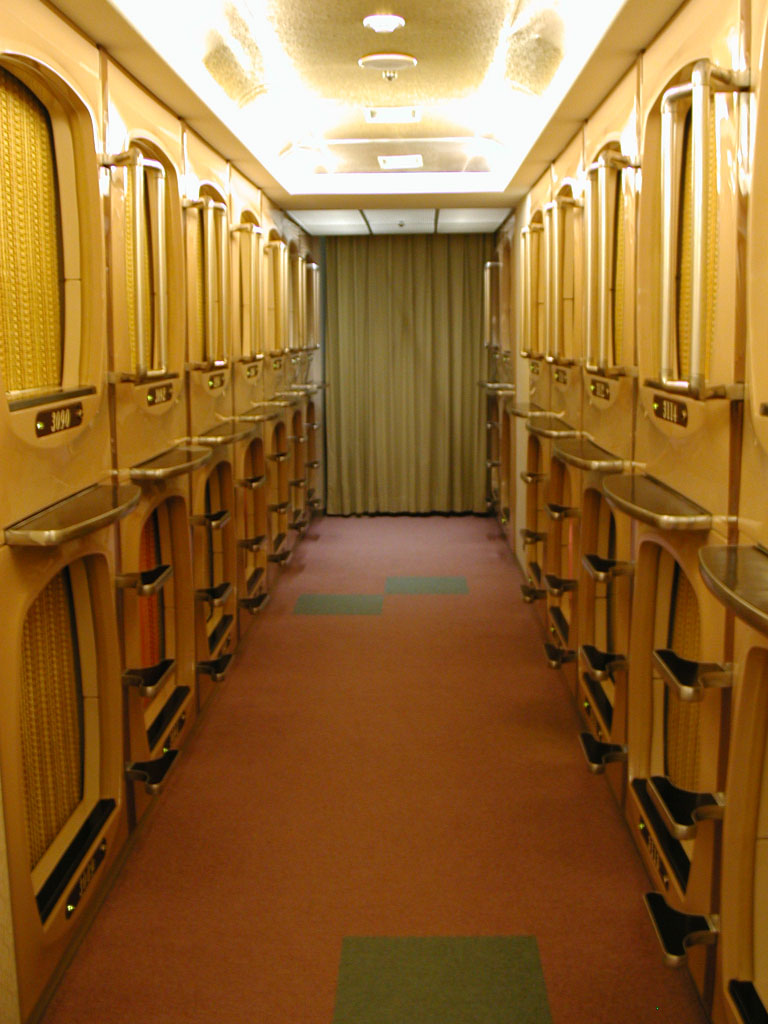
Though glamorous in their own rights, these ritzy getaways might be a little overwhelming for the average traveler or the frugal businessman. For someone who wants a quick nap or brief escape from the terminal environment, a new alternative comes in pod form, an idea adapted from Japanese pod hotels in the late 20th century. Designed by Japanese architect Kisho Kurokawa, the Capsule Inn Osaka opened in 1977 and was the first pod hotel, “with more than a passing resemblance to the drawers in a morgue…a weird but nifty addition to Japan’s space-starved cityscapes” (Buhrstein).view of sleeping compartments in a pod-style hotel in Japan

Originally designed for businessmen in transit, the pod idea easily conforms to the similar airport transit setting. Several companies have realized and adapted this concept. In Vancouver, MetroNaps opened in 2004, and installed several pod spaces in the middle of the airport to give travelers space for rest. Each pod consists of a giant bulbous fiberglass helmet over the top of a contoured chaise lounge. Once the helmet is secured, music is played in the sphere.
MetroNaps pod for rest

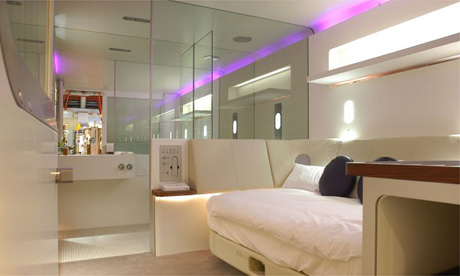
The most recent modification of the original pod system was accomplished by Simon Woodroffe, the CEO of the company that owns Yotel!. He envisioned an adapted version of the old Japanese hotel and created the futuristic pod-style hotels that currently exist in Gatwick and Heathrow airports in London. At Yotel, one can choose to stay any amount of time from the minimum of four hours and longer. Because it only takes “30 minutes to clean and ready a room for the next guest, compared with two to three hours at a typical hotel…daily occupancy runs between 150% to 180% since rooms can turn over more than once a day” (Jackson). This is an extraordinary figure that can boost profit margins considerably. Despite their small sizes that can measure as little as 65 square feet, airport pod hotels around the world are not without their amenities. Some offer gourmet room service, private bathrooms, “42-inch plasma TVs, heated bathroom mirrors that don’t fog, and Phillipe Starck designed décor” (Jackson). These economical but trendy capsule rooms match the discount airline trend of low frills and low cost. They save on costs by not needing as much labor to provide extra services, and in fact, there are “as few as one full-time employee for every 12 rooms at a pod hotel, compared with an employee for every two rooms in a typical budget hotel” (Jackson). As a cost-effective way of providing a place to rest, the space-saving pod-hotels also save on the amount of real estate on airport properties, an attribute most likely welcomed by airport architects, dollar-conscious CEOs, and environmentally conscious consumers.rooms in a Yotel pod-hotel

The newest variation on the small-room, low cost room idea will open for its first booking in Sweden at the Stockholm-Arlanda Airport this upcoming December. This innovative hostel is not only on the airport property, but is completely reconstructed from the interior of “a worn out jumbo jet of the model 747-200 built in 1976” (Histories). Named Jumbo Hostel, the idea is simply to have the same basic attributes of a hostel that can be found in similar large cities in Europe. Owner Oscar Dios, who also operates the Uppsala Vandrarhem och Hotell hostel, jumped at the opportunity in 2006 to buy and redo the old jet in order to take advantage of the two-for-one deal of saving on the cost of airport property and construction costs. Viewing the new budget living proposal as a landmark to stand at the entrance of the airport, authorities at Arlanda agreed to let the jet remain on the property. 450 seats were taken out to put in 25 rooms with three bunk beds each. Larger rooms such as the redesigned cockpit suite have its own bathroom. The entire plane works within Swedish building, climate, environmental, and energy regulations.
views of Jumbo Hostel, exterior and proposed interior

Although these airport options are soon to be or are already available for stranded travelers to choose, the majority of airports are still unable to provide sufficient places of rest. Sometimes the passenger must simply make do with what they are presented at the airport where they are stranded. Donna McSherry is a Canadian that understands the concerns of budget travelers. Her website www.sleepinginairports.com is a guide for people who are money conscious and travel weary. When the site was first launched in 1996, there were a measly three reviews. At the time of the last update on July 19, 2008, there were counted more than 5500 reviews of not only airports, but buses and trains as well (About). Airports, however, are the specialty of this site, and “Sleeper Scores” are assigned to each of the reviewed destinations, along with first-hand quotes and lists of amenities. Singapore Changi currently ranks as the best airport to sleep in, with Paris’s Charles de Gaulle airport ranked as the most hated. With amusing illustrations rather than actual pictures (the only thing that’s lacking on this site), the entire idea seems quite comical. Yet, the public response to this helpful guide is positive, and even major publications (New York Times, Time Magazine, etc) as well as the Frommer’s guide books approve.
Singapore Changi Airport's new terminal 3

The current situation of the airline industry may seem grim in light of the fluctuating economy and the quickly increasing numbers and needs of businesspeople and leisure travelers. Delays and passenger load capacities are at an all-time high. In the event of an air traffic emergency, whether due to uncontrollable or controllable occurrences, hundreds to thousands of passengers can be stranded at the gloomy limbo phase that is the layover terminal. Because it is essential for consumers to be comforted in times of high stress, several solutions have been devised to allow displaced travelers a place to rest. After examining options such as traditional airport hotels, pod-hotels, hostel jets, and the making-do-with-what’s-there tactic, there cannot be a consensus on the best option unless more factors are considered for each unique situation. Which airports are most in need of affordable housing options for travelers, and which can actually afford to construct one that will entice travelers to want to enter and enjoy? For some venues, the super sophisticated luxury hotel is the best option, while for others, a more affordable capsule room-by-the-hour will do the trick. Regardless of how travelers are getting more affordable ways of waiting out a flight, the important thing is that some designers and innovators recognize the context of the airline industry in our mobile world today and are addressing the problems that derive from it. How airline traveler accommodation will further improve in the future is yet to be seen, but there will certainly be developments as long as there is still the draw of producer and consumer benefits in this highly profitable airport hospitality industry.


Works Cited

Burshtein, Karen. "The Incredible Shrinking Room; Pods; More low-cost hotels crop up for budgettourists." National Post, October 20, 2007, national edition. http://www.canada.com/topics/travel/story.html?id=a6be0eec-345c-4187-9751-b9d36c1e657b (accessed October 10, 2008).

"Fact Sheet: A System Under Stress: Aviation Congestion." Federal Aviation Administration.
http://www.faa.gov/news/fact_sheets/news_story.cfm?newsId=8807 (accessed October 18, 2008).

Frank, Thomas. "U.S. flights hit peak loads in 2007." USA TODAY, March 25, 2008.
http://www.usatoday.com/travel/flights/2008-03-25-insideroutes_N.htm (accessed November 1, 2008).

Heydari, Farhad. "World's Best Airport Hotels." Forbes Traveler. http://www.forbestraveler.com/resorts-hotels/best-airport-hotels-story.html (accessed October 13, 2008).

"History and Curiosities." Jumbo Hostel. http://jumbohostel.com (accessed November 1, 2008).

Jackson, Candace. "A Pod of One's Own." Wall Street Journal, April 12, 2008.
http://www.djreprints.com/link/DJRFactiva.html?FACTIVA=wjco20080412000036 (accessed October 10,2008).

"July 2008 Airline Traffic Data." Bureau of Transportation Statistics. http://www.bts.gov/
press_releases/2008/bts049_08/html/bts049_08.html (accessed November 1, 2008).
Lawson, Fred. Hotels and Resorts: Planning, Design, and Refurbishment., 41. Architectureal Press,1995. http://books.google.com/books?id=TTmbB10De0gC&printsec=frontcover (accessed November 1,2008).

McCartney, Scott. "Canceled Flight? Your Inn Trouble." Wall Street Journal, April 2008.
http://p9003-www.lib.utexas.edu.ezproxy.lib.utexas.edu/sfx_local?genre=article&isbn=&issn=00999660&title=Wall%20Street%20Journal%20-%20Eastern%20Edition& volume=251&issue=88&date=20080415&atitle=Canceled%20Flight%3F%20Your%20Inn%20Trouble.&aulast=McCartney%2C%20Scott&spage=D1&pages=sid=EBSCO%3AAcademic%20Search%20Complete (accessed October 16, 2008).

McCartney, Scott. "The Middle Seat: A Downside of Cheap Fares: Flight Cuts --- Routes Vanish In Low-Fare Cities;Grounding 737s." Wall Street Journal, September 30, 2008. http://www.djreprints.com/link/DJRFactiva.html?FACTIVA=wjco20080930000027 (accessed October 16, 2008).

McSherry, Donna. “About This Site.” The Guide to Sleeping in Airports. http://sleepinginairports.com/about.htm (accessed November 1, 2008).

Reed, Dan. "Airlines Stretched So Thin that One Piece Out of Place..." USA Today, March 14, 2008,national edition. http://ezproxy.lib.utexas.edu/login?url=http://search.ebscohost.com/
login.aspx?direct=true&db=a9h&AN=J0E049517161407&site=ehost-live (accessed October
14, 2008).

Sturgell, Robert A. "Growth Ahead, But There's a But." Speech, Forecast Conference, Washington,D.C., March 10, 2008. Federal Aviation Administration. http://www.faa.gov/news/speeches/news_story.cfm?newsId=10185 (accessed November 1, 2008).

"Yotel Overview." Yotel. http://www.yotel.com (accessed November 1, 2008).

Image Sources

http://airport.all-hotels.com/images/hotels/travco/KEM-KEM_FRONT.jpg
http://blogs.dallasobserver.com/unfairpark/grand%20hyatt%20dfw.jpg
http://www.links.net/vita/trip/japan/lodging/capsulehotel/pix/facing-lg.jpg
http://www.freshpilot.com/metronaps-energypod-a-room-inside-a-room/
http://static.guim.co.uk/sys-images/Travel/Pix/pictures/2006/12/15/Yotel_X460.jpg
http://www.smh.com.au/ffximage/2007/07/27/Yotel_wideweb__470x314,0.jpg
http://www.jumbohostel.com/DynPage.aspx?id=64667&mn1=5293&mn2=5303
http://www.jumbohostel.com/Graphics/16524.jpg
http://www.cpgcorp.com.sg/admin/files/newsletter/Issue%202%202008/T3_checkin_hall.jpg